





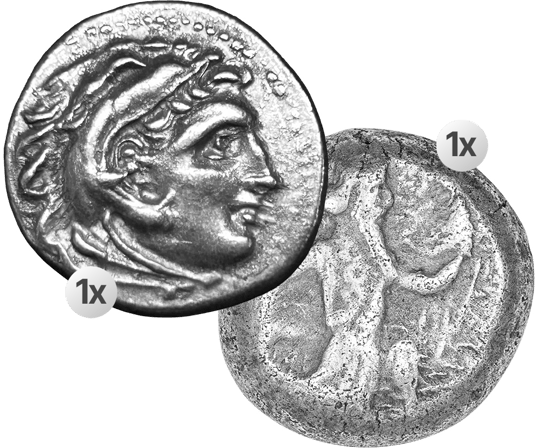


Silver Set Battle of Gaugamela (331 BC | Alexander the Great and Darius III)












- Genuine Originals: hand-struck
- Both Rivals: Macedon and Persia
- Legendary Designs: heroes and gods
- Genuine OriginalsNo restrike, but genuine silver from antiquity
- Both RivalsDrachm from Macedon and Siglos of the Achaemenids united
- Legendary DesignsHerakles in lion's skin, Zeus with eagle, Great King with bow

 Price alert
  Share
ShareAncient original
The hellenistic ageSet for the battle of Gaugamela


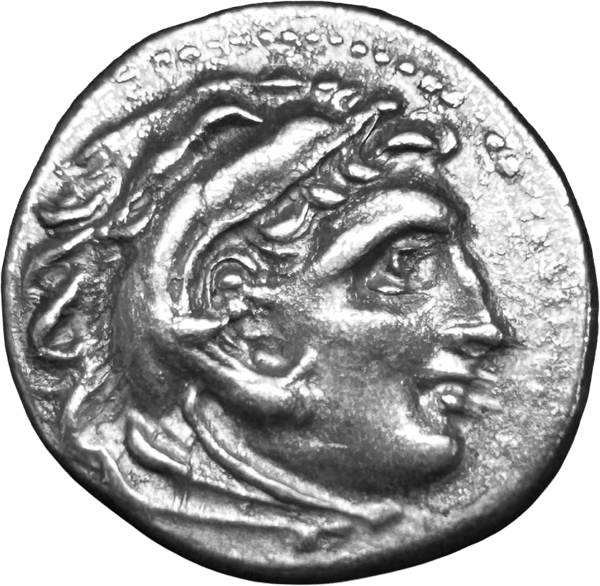
You are looking at the front.
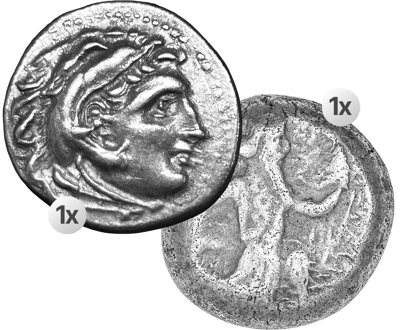
This offer contains more than one piece. The first image shows them together.
Between the day someone struck this piece with a single hammer blow and the day you hold it, there are roughly
2,350years
- Struck by hand
- Original, not a restrike
- 30 days return policy
Where it belongs
Eleven epochs, a thousand years, one shelf.
With Alexander the coin became a mass medium. His type, Herakles in the lion skin on one side and Zeus enthroned on the other, ran from Macedonia to the Indus and went on being struck for more than two hundred years after his death. His generals divided the empire and put their own heads on the metal, the first portraits of living men in the Greek world.
7th to 5th century BC
Archaic Greece
5th to 4th century BC
Classical Greece
6th century to 330 BC
Achaemenid Persia
5th to 2nd century BC
Carthage
336 to 30 BC
The hellenistic age
Your piece
3rd to 1st century BC
Celtic tribes
27 BC to AD 235
The Roman empire
AD 235 to 284
Crisis of the third century
AD 284 to 313
The tetrarchy
AD 306 to 363
The Constantinian dynasty
AD 395 to 1453
The eastern Roman empire
Keeping it
First things first: do not clean it.
The dark layer on bronze and the matte grey on silver are called patina. It has grown over centuries and collectors treat it as a mark of authenticity. Polishing it away does not give you a nicer piece, it gives you a damaged one: auction houses regularly value a brightly cleaned coin below the same coin with its patina intact.
Hold it by the edge
Fingerprints contain acid and salt. Take the piece between thumb and forefinger by the rim, over a soft surface.
Store it dry and dark
Moisture is the only real enemy. A pouch or a capsule in a dry place is enough; PVC sleeves are not, they attack the surface.
No agents, no brush
No vinegar, no silver cloth, no ultrasound. If you want a crust removed, let a conservator do it, not the kitchen sink.
Gaugamela in Silver: Two World Empires, Two Original Coins
On 1 October 331 BC, the dusty plain of Gaugamela decided who would rule the then-known world. On one side stood the young Macedonian king Alexander III, on the other Great King Darius III, master of the mighty Achaemenid Empire. Alexander was victorious – and a kingdom on the fringes of the Greek world became an empire that stretched all the way to the Indus. This set brings both contenders together. Not as a modern restrike, but as two genuine, hand-struck silver coins from precisely that era.
The Set's Contents at a Glance
- 1x Ancient Silver Drachm of Alexander the Great (356–323 BC) – approx. 4.00 g silver, Kingdom of Macedon
- 1x Ancient Persian Silver Coin of Great King Darius III (336–330 BC) – approx. 5.40 g silver, Achaemenid Empire
Heracles, Zeus and the Royal Archer
The Macedonian drachm bears on its obverse the head of Heracles in a lion's scalp – the pelt of the Nemean Lion lies like a cap over forehead and neck, with ears and paws finely worked out, surrounded by a beaded border. Through this, Alexander asserted his claim to descent from this hero. The reverse shows Zeus Aëtophoros, the "Eagle-Bearer": the father of the gods enthroned facing left, the eagle on his outstretched right hand, the sceptre in his left, along with remnants of the Greek legend ΑΛΕΞΑΝΔΡΟΥ. This type was struck at numerous mints – for example in Asia Minor at places such as Colophon or Magnesia – and continued to be issued posthumously for decades even after Alexander's death.
The Persian silver coin belongs to the famous siglos type, the silver denomination of the Achaemenids, whose weight was around 5.4 g. It depicts the Great King in the kneeling-running stance as an armed archer – the Greeks simply called these pieces "Toxotai". The thick, often slightly bean-shaped flan, the rough surface, and the boldly struck relief make the character of this early minting art immediately tangible.
Circulated Currency – Every Piece a Unique Item
These coins passed through hands, pouches and temple coffers. They bear the traces of it: darker patina, individual centring, nicks, wear, and in places weaker legend details. This is precisely what makes them appealing. Since the year of minting, mint, and reverse variant may differ, the piece you receive will differ from the image shown – you receive an original, not a mass-produced item. Please understand that the image in the shop is an example, and due to historical circumstances the delivered item may vary individually in appearance and condition.
Two coins, two adversaries, one battlefield: whoever holds this set in their hands holds tangible world history – and genuine silver at the same time.
Silver: A Tangible Asset with a Millennia-Old Tradition
Hardly any product demonstrates so clearly why precious metal inspires trust: these pieces have outlasted empires, dynasties and countless currencies. Silver was a means of payment long before banks existed, and in the form of bars and coins it remains so to this day.
- Value preservation across generations: Silver is durable, corrosion-resistant and retains its physical properties – ideal for passing on wealth.
- Tax aspect: Profits from the sale of physical silver are generally tax-free, provided the holding period is at least one year.
- Intrinsic value: Unlike fiat money, silver is not based on trust in institutions but on its material properties.
- Industrial demand: Electronics, solar technology and medical technology continuously consume silver, while supply remains limited.
- Protection against crises and inflation: As a tradable commodity and medium of exchange, silver retains its significance when currencies falter.
For Collectors and Preservers Alike
Compared to modern bullion coins, this duo scores with an unbeatable argument: history. An industrially manufactured silver coin is perfect, but interchangeable; these ancient strikes are unique pieces with a biography. For this reason, weight, fineness and diameter are naturally not standardised here – those seeking pure weight-based goods should turn to standard products, while those who collect history should choose this set. As a gift for history enthusiasts, as an entry point into ancient numismatics, or as a small, very personal building block of a long-term tangible-asset strategy: this set combines the myth of Alexander with the lustre of a metal that has never gone out of fashion.
Product depiction may differ from the final product.
