






Currency of the Tsars Collection
- New arrival: Product is new in the shop
- Secure shipping: 100% insured & anonymous delivery
- New arrivalProduct is new in the shop
- Secure shipping100% insured & anonymous delivery




- New arrival: Product is new in the shop
- Secure shipping: 100% insured & anonymous delivery
 Price alert
 Share

Money of the Tsars
3 coins, 3 rulers.From a drop of silver to the rouble.
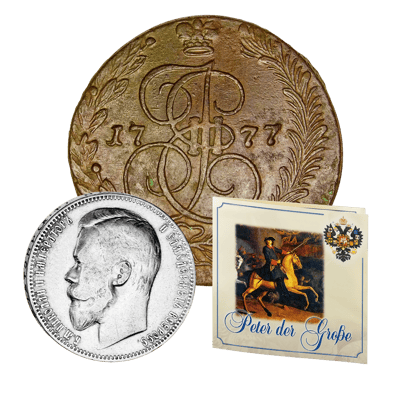
A wire kopek from the time of Peter the Great, 5 kopeks in copper with the monogram of Catherine the Great and 1 rouble in silver with Nicholas II in profile. All 3 are real money that people paid with in the Russian Empire.
- Rulers
- 3
- Metals
- Silver and copper
- Fine silver in the rouble
- 18 g
Silver and copper
A drop of silver, 46 g of copper and a rouble.
Catherine’s 5 kopeks measure 42 mm and weigh 46 g. The rouble of Nicholas II measures 34 mm and weighs 20 g of 900/1,000 silver, 18 g of it fine silver. For the wire kopek in its card only the weight is given, 0.4 g, so it is missing from the comparison of sizes.
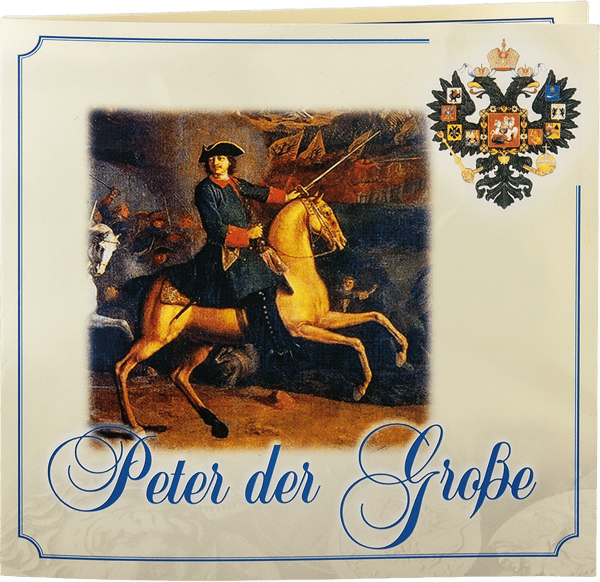
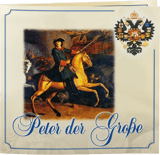 Peter the GreatA wire kopek in silver, 0.4 g, in a card showing Peter on horseback beneath the double-headed eagle.
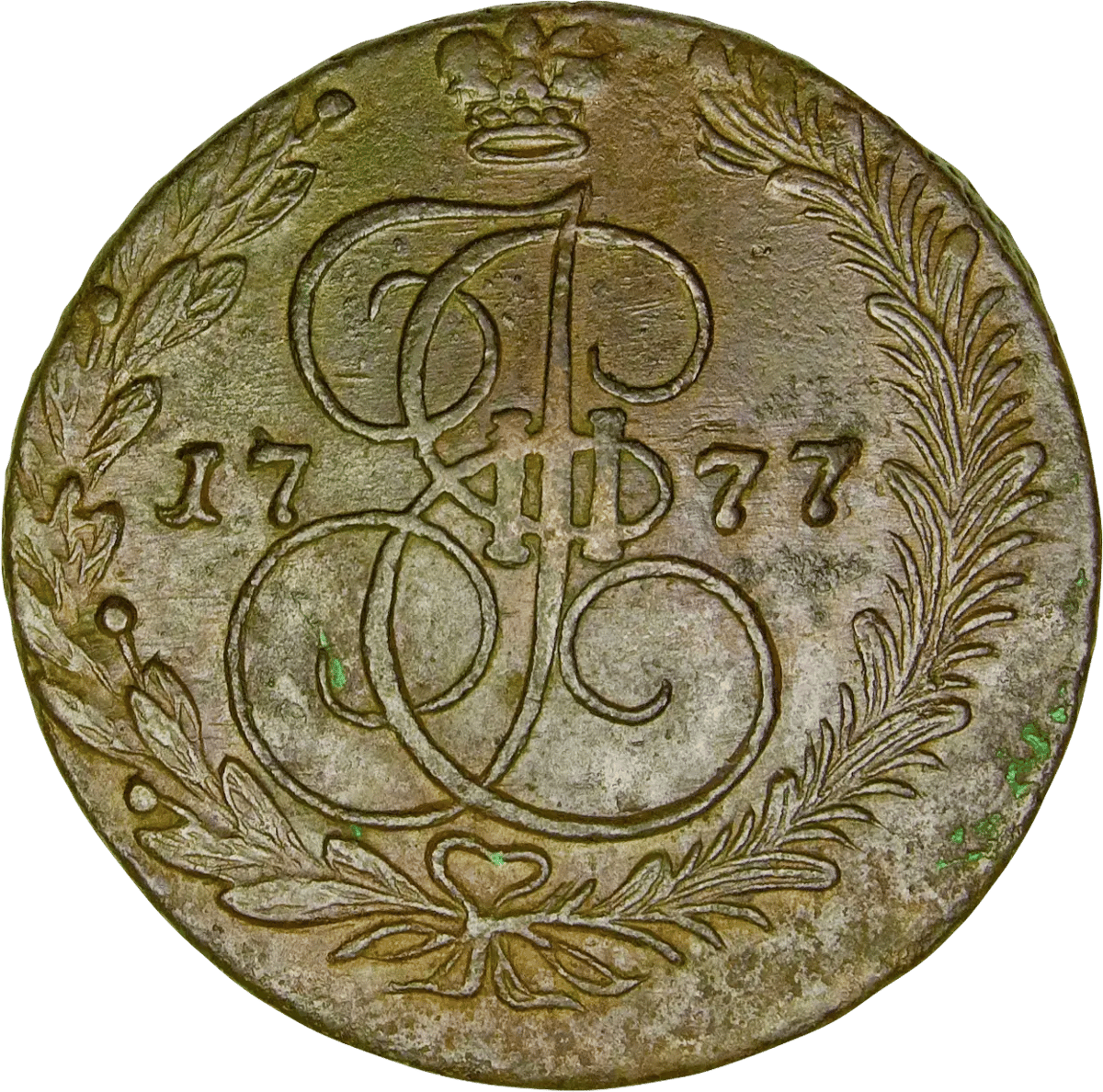
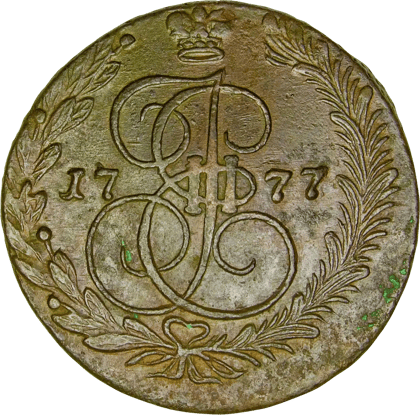
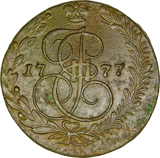 Catherine the Great5 kopeks in copper with the Empress’s crowned monogram, 42 mm and 46 g.
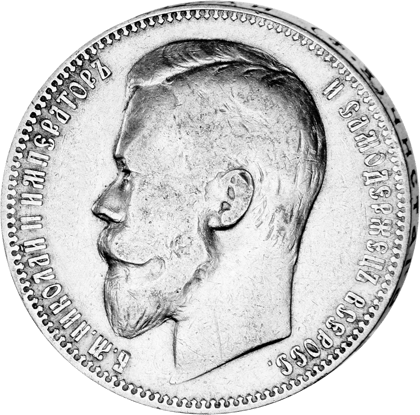
 Nicholas II1 rouble in silver from the years 1895 to 1915, 34 mm. Nicholas II was the last Tsar.

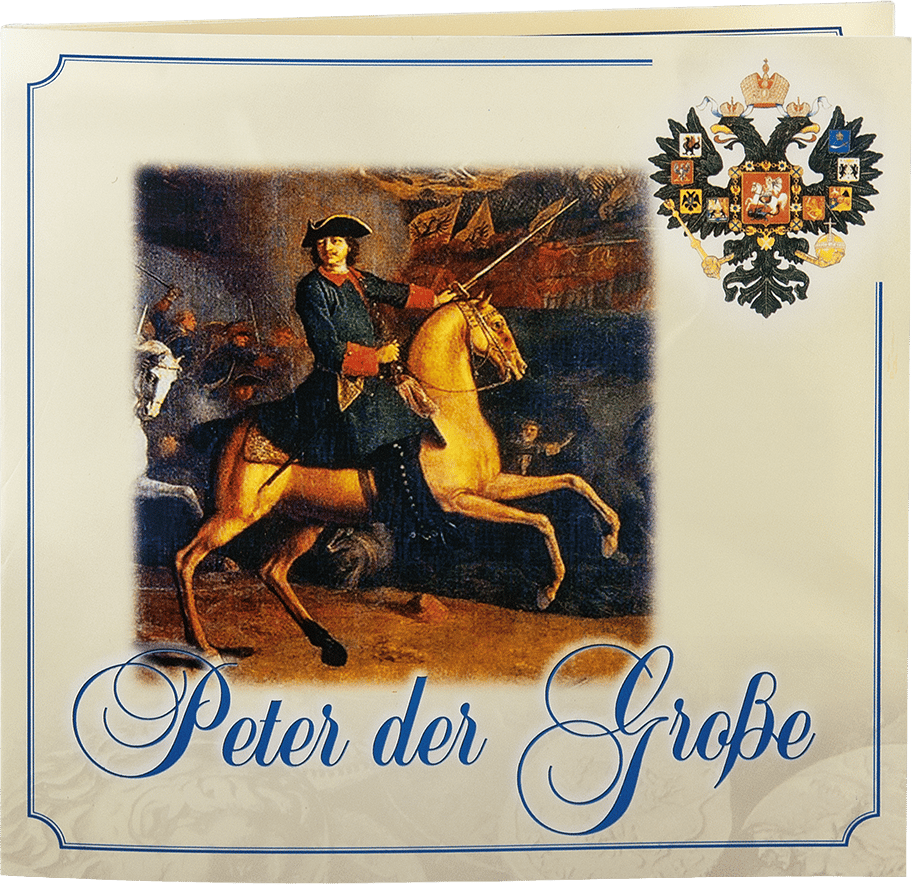
Peter the Great
A drop of silver from the time of Peter the Great.
Wire kopeks were made from silver wire, under Peter until 1718. Peter was born in 1672 and crowned in 1682 at the age of 10. On the card he rides beneath the double-headed eagle, with “Peter der Große” written below.
Struck between 1682 and 1915
Peter, Catherine and Nicholas in the order of their years.
- 1682 to 1718
 Peter the Great
- 1763 to 1796
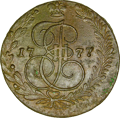 Catherine the Great
- 1895 to 1915
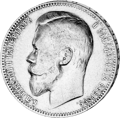 Nicholas II
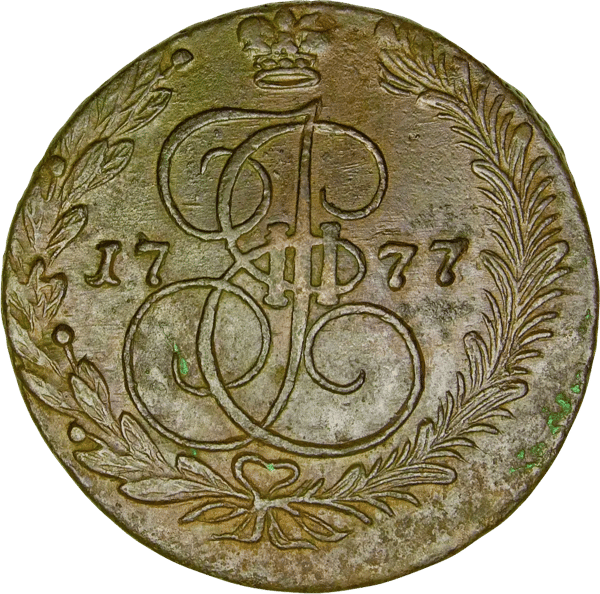
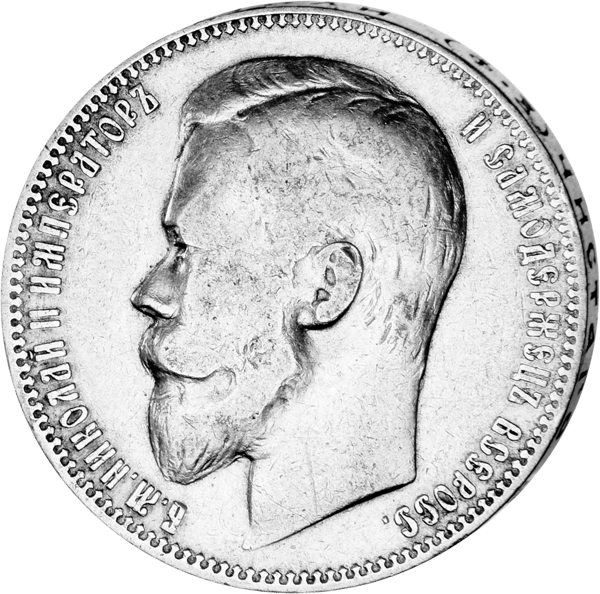
The Empress’s copper, the last Tsar’s silver.Money of the Tsars in 3 coins.
The 5 kopeks bear the crowned monogram of Catherine, who was born in Stettin in 1729. The rouble shows Nicholas II in profile. On the state table they stand side by side; the wire kopek stays in its card.
Currency of the Tsars Collection: three rulers, three coins, two centuries of Russia
Peter the Great. Catherine the Great. Nicholas II. These three names tell the story of the Tsarist Empire, from Russia's rise to European great power status to the end of the Romanov dynasty. The Currency of the Tsars Collection contains one original coin from each of these rulers, with which people paid in markets, taverns and counting houses in their time. This is not a restrike and not a commemorative piece. You receive genuine circulating money made of silver and copper, passed through many hands over generations.
For newcomers to Russian coins, the collection is a compact starting point. Those who already collect cover three eras at once.
What's included in the collection
- 1x Wire Kopeck of Tsar Peter the Great (1672–1725): hand-struck wire kopeck made of silver, approx. 0.4 g, in an illustrated blister card
- 1x 5 Kopecks of Tsarina Catherine the Great (1762–1796): heavy copper coin with crowned monogram, approx. 46 g, around 42 mm in diameter
- 1x 1 Ruble Silver of Tsar Nicholas II (1895–1915): 20 g silver at 900/1,000 fineness, containing 18 g fine silver
Peter the Great: the last kopeck made from wire
Peter I was born in 1672 and was crowned Tsar as early as 1682, at the age of ten. He later travelled through Western Europe with his "Grand Embassy" and even worked in shipyards himself. He founded Saint Petersburg and defeated the Swedes at Poltava in 1709. His wire kopeck marks the end of an almost two-hundred-year-old tradition. For this coin, silver wire was cut into small pieces and flattened between two dies. This produced the characteristic drop-shaped flans. The coin's design, showing the horseman, the lance and the Cyrillic title inscription, is usually only partially visible on it.
The last wire kopecks were struck in 1718. The blister card shows Peter on horseback and the double-headed eagle on the outside. Inside, the Peterhof Palace and a replica die are depicted, revealing the complete coin design.
Catherine the Great: a German princess on the Tsarist throne
Catherine was born in Stettin in 1729 as Sophie Auguste Friederike von Anhalt-Zerbst. In 1762 she proclaimed herself Tsarina and subsequently ruled for 34 years. Her 5 Kopecks is the heaviest piece in the collection, and you notice this immediately when you hold it in your hand. On one side is the crowned monogram "E II" between a laurel and a palm branch. The other side shows the double-headed eagle with sceptre and orb above the inscription "ПЯТЬ КОПѢЕКЪ", meaning "five kopecks". The net-patterned edge was meant to prevent anyone from clipping copper from the coin. This type of Russian kopeck was struck from 1763 onwards, among other places in Yekaterinburg in the Urals. Many pieces from there bear the mint mark ЕМ.
Nicholas II: the last Tsar in silver
On the silver ruble you see the bearded profile of the Tsar, and on the reverse the crowned double-headed eagle. The edge is particularly interesting. It states the silver content in old Russian units of weight: 4 Zolotnik and 21 Dolya. This corresponds to the 18 grams of fine silver still contained in the coin today. Most pieces were struck in St. Petersburg. In the late 1890s, Paris and Brussels also contributed to the minting, after Finance Minister Sergei Witte tied the ruble to gold in 1897. Nicholas II was also related to Kaiser Wilhelm II, as evidenced by the "Willy-Nicky" telegrams exchanged between the two during the July Crisis of 1914.
Condition: traces that tell a story
All three coins were in circulation as currency. The year of issue, mint and condition therefore differ for each piece. You will notice patina, individual centring, nicks or inscriptions struck with varying sharpness. This makes each specimen unique. Precise details on condition can be found in the descriptions of the individual coins. The product images are examples. Your own specimen will look different.
Gold is humanity's oldest currency and has outlived all others. Silver and copper tell the other half of this story, that of everyday circulating money. The Tsarist Empire has long since ceased to exist, but the metal in your hand remains.
Why a set instead of individual coins?
Of course, you can also buy all three pieces individually. However, the set shows at a glance how Russian currency developed: from the hand-struck silver flan, through the heavy copper money, to the machine-struck ruble with a fineness stamp. Anyone collecting historical silver coins also gets a solid silver content with the ruble. For many collectors, precious metal that you can hold in your hand represents a piece of lasting value and protection in uncertain times.
- Three rulers and over two centuries of numismatic history in one collection
- Genuine circulating money instead of a souvenir, each piece with its own history of circulation
- As a gift well suited for history enthusiasts, connoisseurs of Russia and coin collectors
- Good to know: Anyone looking purely to maximise fine weight is better served by modern 999 bullion coins. Here, you buy precious metal and history at the same time.
The complete gold ruble set of Nicholas II covers a single reign. This collection is significantly more affordable and, in return, spans a much longer period of time. Shipping is carried out as insured value shipping.
Product image may differ from the actual product.
