





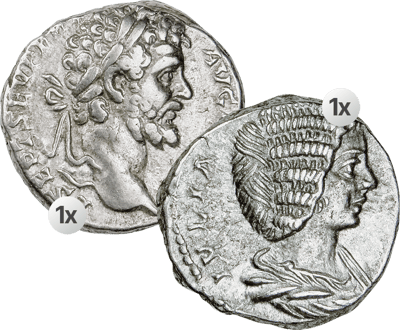


Silver Denarius Imperial Couple Septimius Severus and Julia Domna (187-211 AD)










- Antique Originals: hand-struck coins
- One Dynasty: general and empress
- Rich in Detail: two striking portraits
- Antique OriginalsGenuine coin silver circulated some 1,800 years ago
- One DynastyFounder of the Severan dynasty united with his wife
- Rich in DetailLaureate imperial head and the famous wave hairstyle
 Price alert set
 share
shareThe Imperial Couple of Rome – two genuine denarii from the Roman Imperial era
Two people, one world empire, around 1,800 years of history. This bundle combines the silver denarius of Emperor Septimius Severus with the silver denarius of his wife, Empress Julia Domna. Both pieces are hand-struck originals from the Roman Empire – genuine coin silver that actually circulated as soldiers' pay, market money, and tax payment. You will not receive a modern mass-produced item, but two historical documents that belong together just like the couple they depict.
What's included in the bundle
- 1x Silver Denarius Emperor Septimius Severus (193–211 AD | Victor over Persia), gross weight approx. 3.2 g
- 1x Silver Denarius Empress Julia Domna (187–211 AD | Oriental elegance in Rome), gross weight approx. 3.1 g
In total you hold around 6.3 g of ancient coin silver in your hands, spread across two flans of approximately 17 and 18 mm in diameter. Small, irregularly curved, with visible striking weaknesses at the edge – and precisely for that reason so unmistakable.
Severus: the self-made man from Leptis Magna
Lucius Septimius Severus was born in 146 AD in Leptis Magna, in present-day Libya. In April 193, his Danube army proclaimed him emperor; by 197 he had eliminated all rivals and founded the Severan dynasty. He then marched east. In 197/198 he conquered the Parthian residence of Ctesiphon, celebrated the Victoria Parthica in January 198, and adopted the victory title Parthicus Maximus – a title that appears in coin legends. He died in 211 in Eboracum, present-day York. On the obverse of his denarius you see the laureate head facing right: dense curls, a strong forked full beard, the ribbons of the wreath falling to the neck. Surrounding legends read L SEPT SEV PERT AVG IMP or SEVERVS PIVS AVG. The reverses range from Victoria and Virtus to Mars and war trophies, to Providentia or Africa wearing an elephant headdress.
Julia Domna: the cleverest woman at the imperial court
Julia Domna came from Emesa in Syria, born around 160 AD. In 187 she married Severus, from 193 she was Augusta – and remained one of the most powerful figures of the empire until 217. She accompanied her husband to the military camps, bore the honorary title Mater Castrorum, "Mother of the Camps," promoted philosophy and scholars, and was the mother of two future emperors: Caracalla, who reigned as Marcus Aurelius Antoninus, and Geta. Her portrait is one of the most recognizable in ancient numismatics: the draped bust facing right, along with the famous hairstyle of densely waved hair arranged in tracks, ending in a broad bun at the nape of the neck. Legends usually read IVLIA DOMNA AVG or IVLIA AVGVSTA; the reverses depict deities and personifications such as Vesta, Juno, Venus, Pietas, Fortuna, or Cybele. To this day, the types are classified according to the standard reference work Roman Imperial Coinage (RIC).
Technical data at a glance
- Denomination: Denarius (Denarius) – the leading denomination of the Roman Imperial era
- Country: Roman Empire
- Precious metal: Silver; fineness not specified due to historical circumstances
- Gross weight of set: approx. 6.3 g (approx. 3.2 g + approx. 3.1 g)
- Diameter: approx. 17 and 18 mm
- Year of minting and mint: various
- Production: hand-struck with die and hammer
- Condition: various, circulated coinage
- Investment purpose: collector's item
A word on the silver content: Under Septimius Severus, the fineness of the denarius was significantly reduced – numismatic reference works cite around 50 percent for his reign, with some late issues falling below that. Because the year of issue and mint vary, we deliberately do not state a fixed fineness. The metal is silver, the alloy ancient.
Condition: 1,800 years leave their mark
These pieces are circulated legal tender and bear corresponding traces: darker patina, individual centering, nicks, wear, and in some cases weaker legend areas. This is exactly what makes them appealing. Since the year of minting, mint, and reverse variant may vary, the delivered specimen will differ from the image shown – you receive an original, not a mass-produced item. Please understand that the image in the shop represents an example and may individually differ from the delivered item in terms of appearance and condition due to historical circumstances.
Our care tip: do not clean, do not polish. The natural toning protects the surface and is part of the coin. It is best to handle it only by the edge and store it dry – this preserves its character for generations.
Ancient silver coins as a tangible asset
Ancient silver coins combine the joy of collecting with the concept of tangible assets. For millennia, silver was a monetary metal, a store of value, and a symbol of wealth and prestige – these two denarii are the best proof of that. Gold and silver are humanity's oldest currencies; they have outlasted emperors, wars, and countless paper money systems.
- Physical tangible asset with intrinsic value – independent of trust in fiat money
- Proven as an inflation hedge and crisis protection, traded worldwide as a commodity and highly liquid
- Limited supply amid robust industrial demand from electronics, solar, and medical technology
- Profits from the sale of silver are generally tax-free provided the holding period is at least one year
- Durable and divisible – suitable for passing on wealth as a building block of retirement provision across generations
Comparison: Imperial couple set, single denarius, and antoninianus
A single denarius tells a biography. The pair tells a dynasty – ruler and empress, military commander and Mater Castrorum, military power and court culture in two portraits. Anyone building a Severan collection has the core assembled with this bundle and can later expand it with Caracalla or Geta. Older denarii of a Trajan or Marcus Aurelius contain more fine silver, but in good condition usually cost significantly more. The antoninianus, introduced by Caracalla in 215, appears larger but was less silver-rich than its face value of two denarii promised. Modern bullion coins, by contrast, offer 999 fine silver and exact weights – but no history. This set lies appealingly in between: an affordable entry into ancient numismatics, two unique pieces with a name, a face, and a date.
This denarius once paid Roman legionaries. The paper money of that era has long since disappeared – the silver lies today in your hand.
Ideal for newcomers to antiquity, as a gift with genuine substance, and as a tangible building block of a broadly diversified precious metals collection. Shipping is carried out as insured value shipping.
Product depiction may differ from the final product.
