





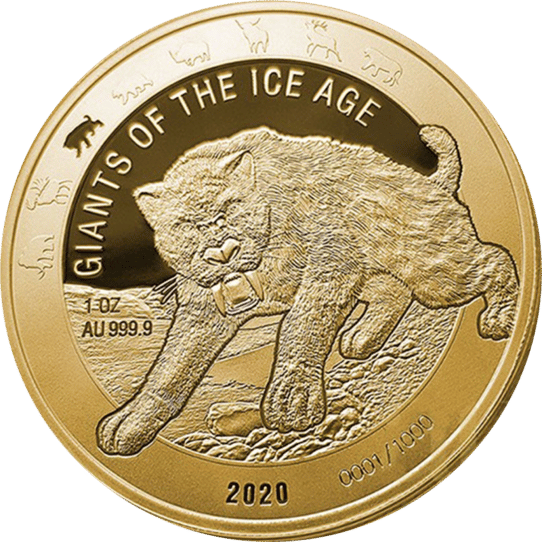


1 oz Gold Giants of the Ice Age - Sabre-Toothed Cat 2020 (Mintage: 1,000 | Proof)
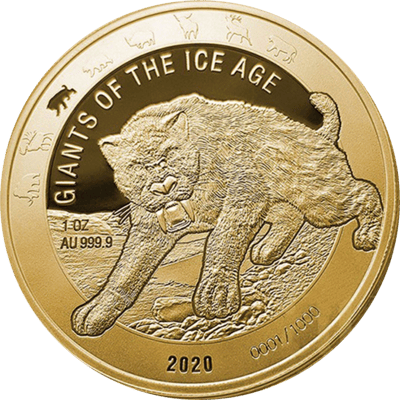













- Successful hunter: of the Ice Age
- Collector series: part 3 of 6
- Fine gold: fineness 999.9/1000
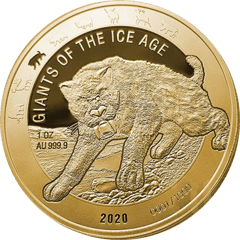
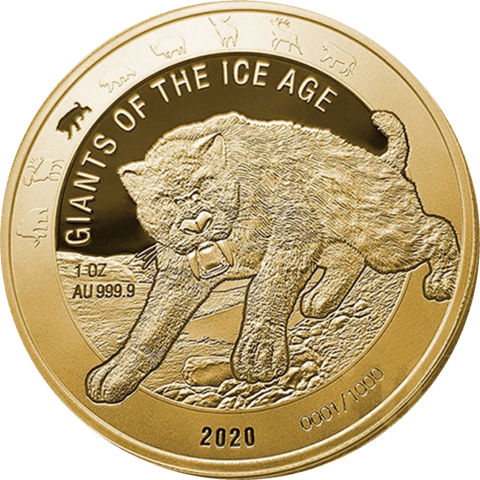
- Successful hunterRunning, jaws open, showing its curved fangs
- Collector seriesSix prehistoric animals, inspired by cave paintings
- Fine goldWeight and fineness are struck on the design side
 Price alert
  Share
Share
Sabre-toothed cat
People still saw them.A sabre-toothed cat in gold.
1 ounce of gold, in proof quality, issuing country Ghana. It died out about 11,000 years ago, at the end of the last Ice Age.
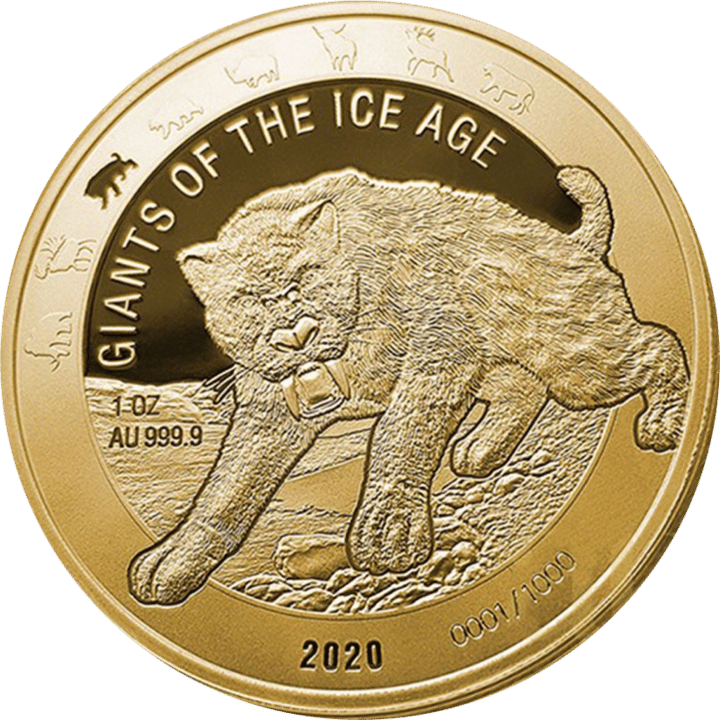

Sabre-toothed cat on 1 ounce of gold, reverse, image
1 ounce of gold, in proof quality, issuing country Ghana. It died out about 11,000 years ago, at the end of the last Ice Age.

In the Americas
More than 2,000 sabre-toothed cats were found in the tar pits of La Brea.
It was not closely related to the tiger.
Sources: La Brea Tar Pits, Los Angeles; Science News
The timeline
From the Devonian to the last Ice Age
Each animal stands in its geological period. The sections show the order, not the duration.
Devonian
about 420 to 359 million years ago
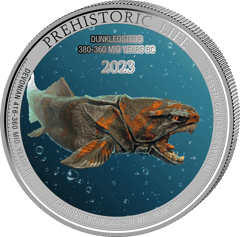 DunkleosteusArmoured fish
Carboniferous
about 359 to 299 million years ago
Permian
about 299 to 252 million years ago
Triassic
about 252 to 201 million years ago
 ArchosaursAnimal group
 PlateosaurusDinosaur
Jurassic
about 201 to 143 million years ago
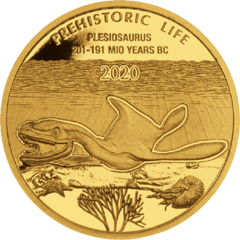 PlesiosaurusMarine reptile
 StegosaurusDinosaur
 BrachiosaurusDinosaur
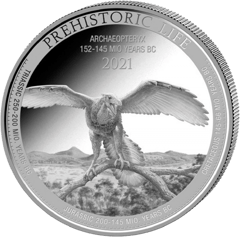 ArchaeopteryxEarly bird
Cretaceous
about 143 to 66 million years ago
 UtahraptorDinosaur
 AustralovenatorDinosaur
 PteranodonPterosaur
 ParasaurolophusDinosaur
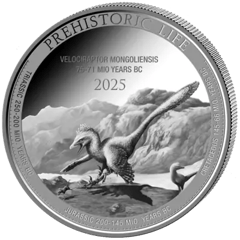 VelociraptorDinosaur
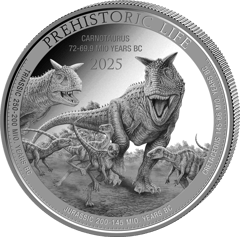 CarnotaurusDinosaur
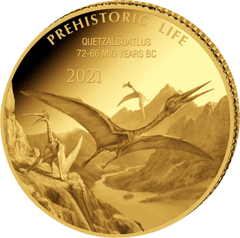 QuetzalcoatlusPterosaur
 TriceratopsDinosaur
 T. rexDinosaur
- The age of the dinosaurs ends 66 million years ago.
Palaeogene
66 to about 23 million years ago
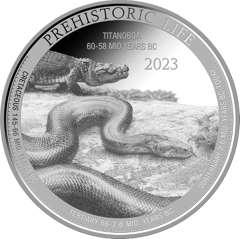 TitanoboaSnake
Neogene
about 23 to 2.6 million years ago
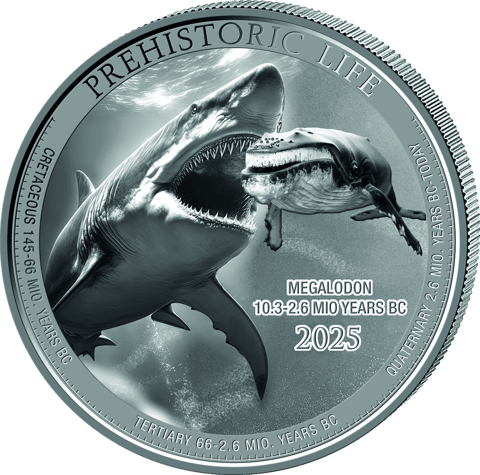 MegalodonShark
- The human genus begins about 2.8 million years ago.
Pleistocene
about 2.6 million to 11,700 years ago
 Sabre-toothed catMammal
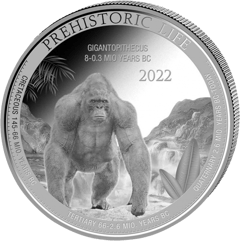 GigantopithecusGreat ape
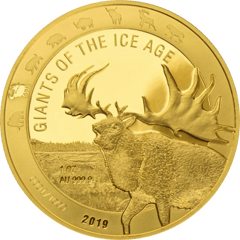 Giant deerMammal
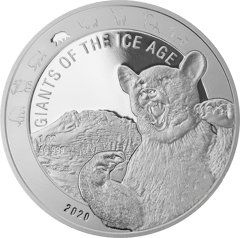 Cave bearMammal
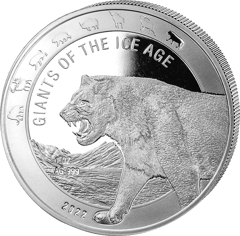 Cave lionMammal
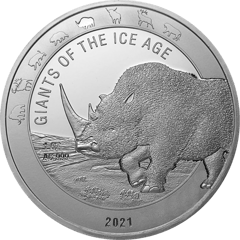 Woolly rhinocerosMammal
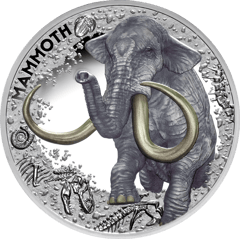 MammothMammal
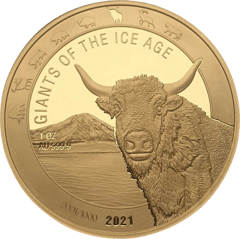 AurochsMammal
- Homo sapiens has existed for about 300,000 years.
- People enter the Chauvet Cave about 36,500 years ago.
Not to scale. Dates according to the International Commission on Stratigraphy, rounded.
The coin
Giants of the Ice Age
The series from Ghana began in 2019 with the woolly mammoth and the giant deer.
The reverse shows the animal in its landscape, and a frieze of animals runs around the rim. The obverse bears the coat of arms of Ghana.

At a glance
- Issuing country
- Ghana
- Face value
- 500 cedis
- Metal
- gold
- Weight
- 1 ounce
- Diameter
- 38.6 mm
- Quality
- Proof
- Fineness
- 999.9/1,000
- Mintage
- 1,000 pieces
- Year
- 2020

In the Americas, humans and sabre-toothed cats knew each other.
1 Unze Goldmünze Giganten der Eiszeit – Säbelzahnkatze 2020 PP im Etui
Diese beeindruckende Serie widmet sich in gebührendem Respekt den Bestien, auf die einst sogar noch unsere Vorfahren Jagd machten – oder vielleicht gar selbst zur Beute wurden! Knochen und Höhlenmalereien regten die Fantasie der Designer an, das Andenken an die Giganten der Eiszeit zu bewahren. Das Ergebnis ist eine Serie mit sechs prähistorischen Tieren, vor einer eiszeitlichen Landschaft malerisch in Szene gesetzt.
Das 3. Motiv erinnert an den einst erfolgreichen Jäger der Eiszeit, dessen Namen bereits auf das einzigartige Charakteristikum dieser urzeitlichen Katze verweist: die äußerst langen gebogenen Eckzähne, die bis zu 28 cm messen konnten. Bei der Jagd, so die Paläontologen, öffnete die Katze Ihren Unterkiefer im 95-Grad-Winkel und schlug Sie wie Messer in den Hals der Beute, als diese bereits am Boden lag. Sie durchtrennten blitzschnell die Halsschlagader und die Luftröhre. Der eiszeitliche Jäger musste diese Zähne stets pflegen und beim Einsatz darauf achten, dass diese nicht abbrachen. Die letzte Säbelzahnkatze starb vermutlich vor 300.000 Jahren aus.
Product depiction may differ from the final product.
