




Unfortunately, this item is currently out of stock. We will be happy to send you an e-mail as soon as this product becomes available again.
 Proven investment and collector's piece
- Free shipping within Germany
- Golden history with springbok design
- Investment classic: The 1 ounce gold Krugerrand 1975 stands for enduring value and is a sought-after collector's piece
- Free shipping: Enjoy the convenience of free shipping within Germany for this precious metal treasure
- Historic symbol: Own a piece of history with the iconic springbok design and the portrait of Paul Kruger
 Price alert set
 share
shareKrugerrand · 1975 Issue
The leap that began in 1967.
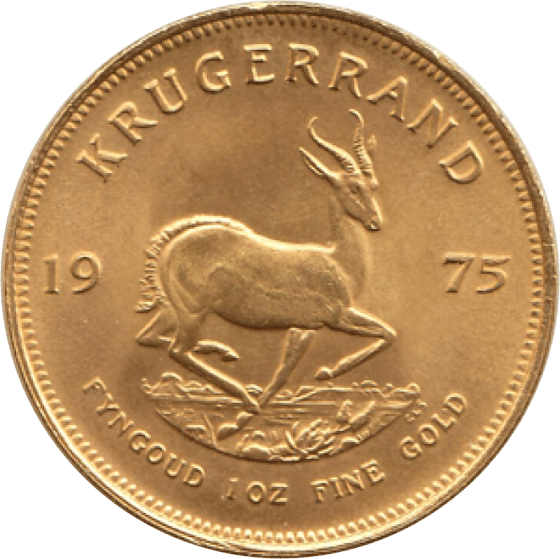

You are looking at the side with the springbok.
Gold for the hands of ordinary people.
In the late 1960s, around three quarters of the western world’s gold came from South Africa. The Chamber of Mines wanted ordinary people, too, to be able to own gold.
With the Krugerrand, a new kind of coin came into being for this purpose: exactly one ounce of fine gold, with no face value struck on it. Its value was meant to come directly from the gold it contains.
6,012,293
Krugerrand bullion coins were issued in 1978 alone, 187 tonnes of gold in all.
A leap through history
1886
Gold on the Witwatersrand
On the Witwatersrand, the ridge of white water, rich gold deposits are discovered. South Africa’s currency is also named after it: the rand.
1947
The springbok
The sculptor Coert Steynberg draws his springbok in 1946 and 1947. It first appears in 1947 on the 5-shilling coin marking the visit of the British royal family.
1967
The first Krugerrand
On 3 July, commissioned by the South African Reserve Bank and the Chamber of Mines, the South African Mint strikes the first Krugerrand.
1980
Smaller sizes
The half ounce, the quarter ounce and the tenth ounce are added so that smaller sums can also be invested in gold.
2017
Fifty years
For the anniversary, the first silver Krugerrand appears, along with the 1/20 and 1/50 ounce in gold. For these coins, the designers go back to the original wax models and designs.
The motif
The springbok and the president
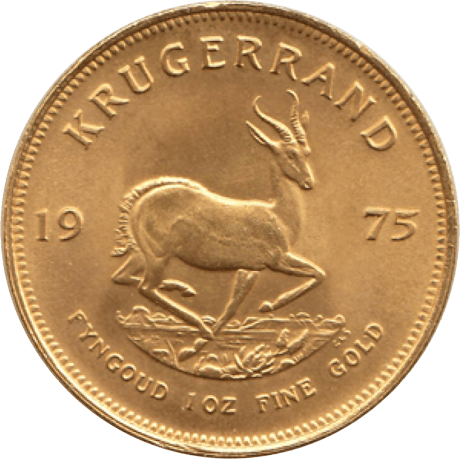
- The springbok
- South Africa’s national animal in mid-leap. The springbok owes its name to its characteristic leaps. It was designed by the sculptor Coert Steynberg.
- The aloe
- The motif includes an Aloe claviflora, one of South Africa’s best-known aloes. It grows in the dry interior of the country, where the springbok is also at home.
- Fyngoud
- Below the springbok is the fine gold content, framed by FYNGOUD in Afrikaans and FINE GOLD in English. Fyngoud means fine gold.
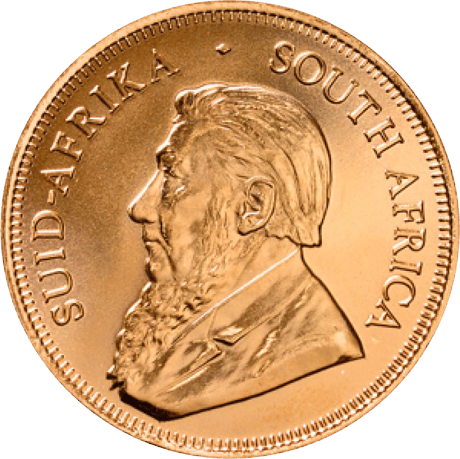
- Paul Kruger
- The other side shows Paul Kruger in profile. In 1883 he became president of the South African Republic, also known as the Transvaal. The portrait was created by the die engraver Otto Schultz. According to the South African Mint, it goes back to the Kruger half-crown of 1892.
- The name
- Krugerrand combines the name Kruger with the rand, South Africa’s currency.
The alloy
Eleven parts gold, one part copper
The Krugerrand is made of 22-carat gold: eleven twelfths fine gold and one twelfth copper. The copper makes the coin harder and more resistant to scratches. It also gives the coin its warm, reddish sheen.
Every coin contains its full weight in fine gold, and the copper is added on top. That is why the one-ounce coin weighs 33.93 grams and yet contains exactly one ounce of fine gold.
The South African Mint produces the bullion coins together with the Rand Refinery. The refinery in Germiston was founded in 1920 so that South Africa’s gold no longer had to be shipped to London for refining. There, refined gold is cast into strips, rolled and punched into coin blanks.
The same leap since 1967.
This issue too.
By its 50th anniversary in 2017, more than 60 million Krugerrands had been sold. The 1975 issue is part of this story, and the story goes on, in your hand and perhaps one day in the hand of someone you pass it on to.
31.1 g fine gold · 916.67/1,000
· Brilliant uncirculated · Coin capsule
Issuing country: South Africa. The South African Mint is a wholly owned subsidiary of the South African Reserve Bank.
1 Unze Gold Krügerrand 1975
- Motiv: Der südafrikanische Springbock
- Material: Gold mit einer Feinheit von 916,66/1.000
- Investitionsziel: Wertanlage
- Herkunft: Südafrika
- Lieferung: erfolgt gekapselt
✔ Wissenswertes zur Krügerrand
Der Krügerrand ist eine südafrikanische Anlage- und Kurantmünze und wurde im Jahr 1967 eingeführt. Die Münze hat zwar keinen Nennwert, ist in Südafrika aber trotzdem ein gesetzliches Zahlungsmittel. Damit der Krügerrand robuster und kratzfester wird, mischt der Hersteller einen kleinen Anteil an Kupfer bei. Daher kommt auch die rötliche Farbe der Münze.
✔ Wissenswertes zum Springbock
Auf der Rückseite dieser Goldmünze ist der südafrikanische Springbock eingeprägt. Der Springbock hat, wie eine Gazelle, einen schlanken Körper und lange, dünne Beine. Er kann eine Schulterhöhe von bis zu 90 Zentimeter erreichen und bis zu 50 Kilogramm auf die Waage bringen. Der Springbock gilt als das Nationaltier von Südafrika.
Zudem sind auf der Rückseite auch das Prägejahr der Münze (1975) und die Stückelung (1 Unze) eingeprägt.
✔ Wissenswertes zu Paul Kruger
Auf der Vorderseite der Münze ist das Porträt von Paul Kruger abgebildet. Paul Kruger war ein südafrikanischer Politiker und von 1883 bis 1902 sogar Präsident der Südafrikanischen Republik. Er setzte sich für die Unabhängigkeit seines Landes ein und wehrte sich gegen die Herrschaft der Briten. Die Krügerrand wurde nach ihm benannt.
✔ Informationen auf einen Blick
- Hersteller: Rand Refinery
- Stückelung: 1 Unze
- Prägejahr: 1975
- Durchmesser: 32,77 mm
- Gewicht: 33,93 Gramm
✔ Informationen zum Schluss
Falls Sie zu dieser Münze noch eine Frage haben, oder zu einem anderen hochwertigen Produkt aus unserem Sortiment, dürfen Sie jederzeit mit uns Kontakt aufnehmen.
Weitere Krügerrand Münzen finden Sie hier.
Product depiction may differ from the final product.