





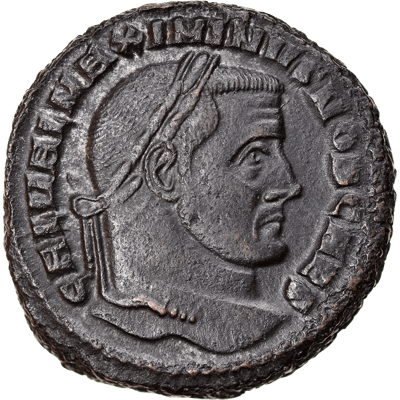
Bronze Follis Emperor Maximinus II (305-313 AD | Last Official Pharaoh)
- Genuine Original: over 1,700 years old
- Emperor's Portrait: clearly visible without a magnifier
- Silver Wash: bright sheen on patina
- Genuine OriginalNo restrike, but real money from everyday Roman life
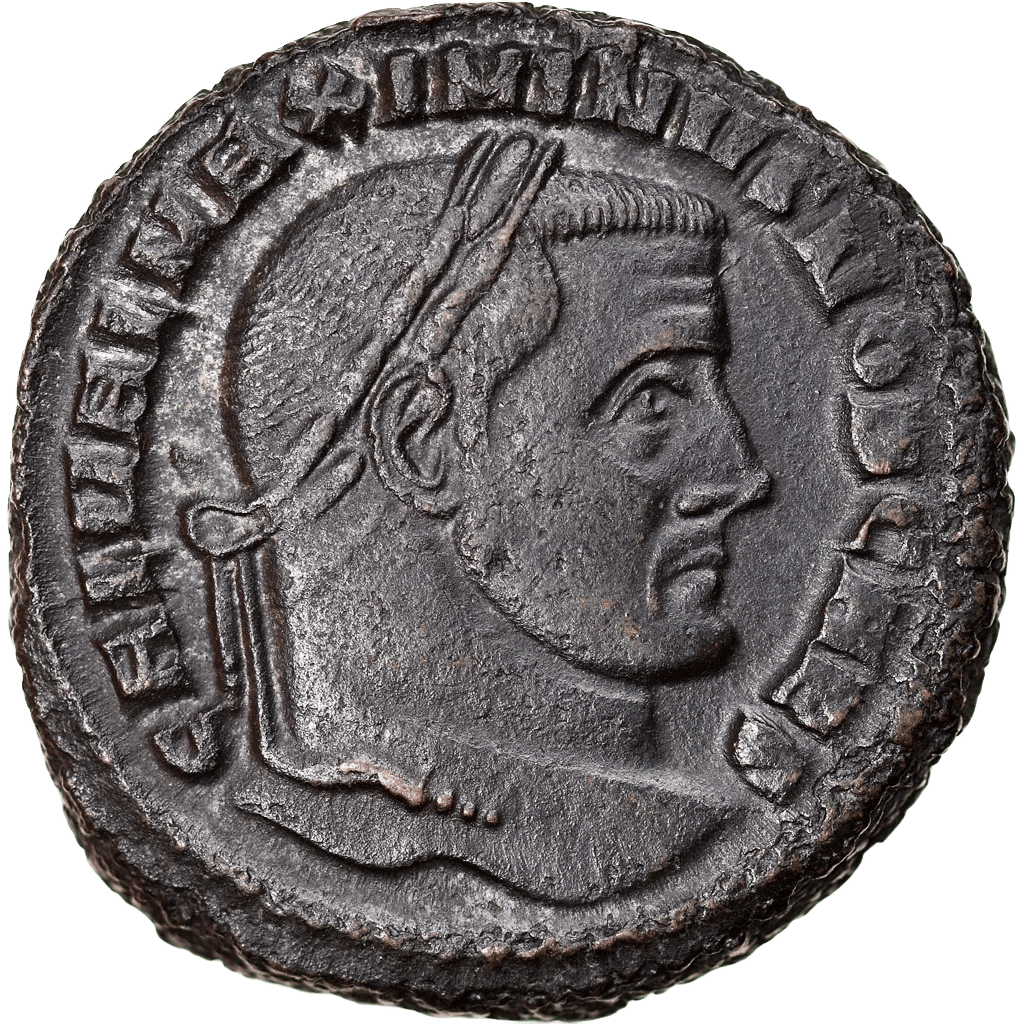
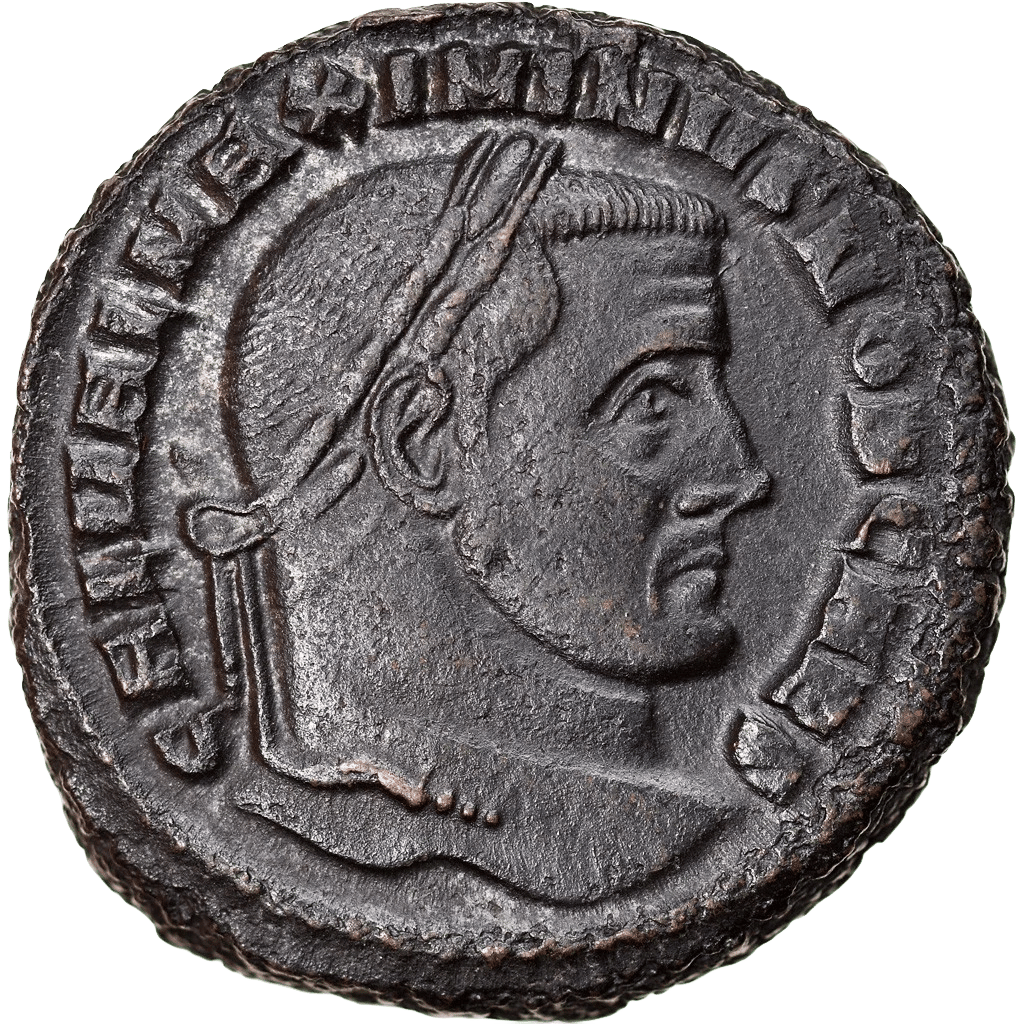
- Emperor's PortraitLaurel wreath, hair and beard are finely detailed
- Silver WashBright highlights shimmer over dark, natural patina




- Genuine Original: over 1,700 years old
- Emperor's Portrait: clearly visible without a magnifier
- Silver Wash: bright sheen on patina
 Price alert
 Share

Ancient original · The tetrarchy
Large follis of Maximinus IIAbout 1,700 years old.
Maximinus II was a nephew of Galerius. In 305 he became Caesar, in charge of Syria and Egypt; in 310 he took the title Augustus.
- Ruler
- Maximinus IIAD 305 to 313
- Diameter
- 20 to 24 mm
- Weight
- c. 7 g
Maximinus II was a nephew of Galerius. In 305 he became Caesar, in charge of Syria and Egypt; in 310 he took the title Augustus.
- Ruler
- Maximinus IIAD 305 to 313
- Diameter
- 20 to 24 mm
- Weight
- c. 7 g

The tetrarchy · AD 284 to 313
4 rulers, a new coin: the follis.
Diocletian ended the crisis with a radical rebuild: four rulers, two Augusti and two Caesares, each for one part of the empire. With it came a new, heavy bronze coin, today called the follis. The portraits of these years look very much alike: what is shown is the office, not the person.
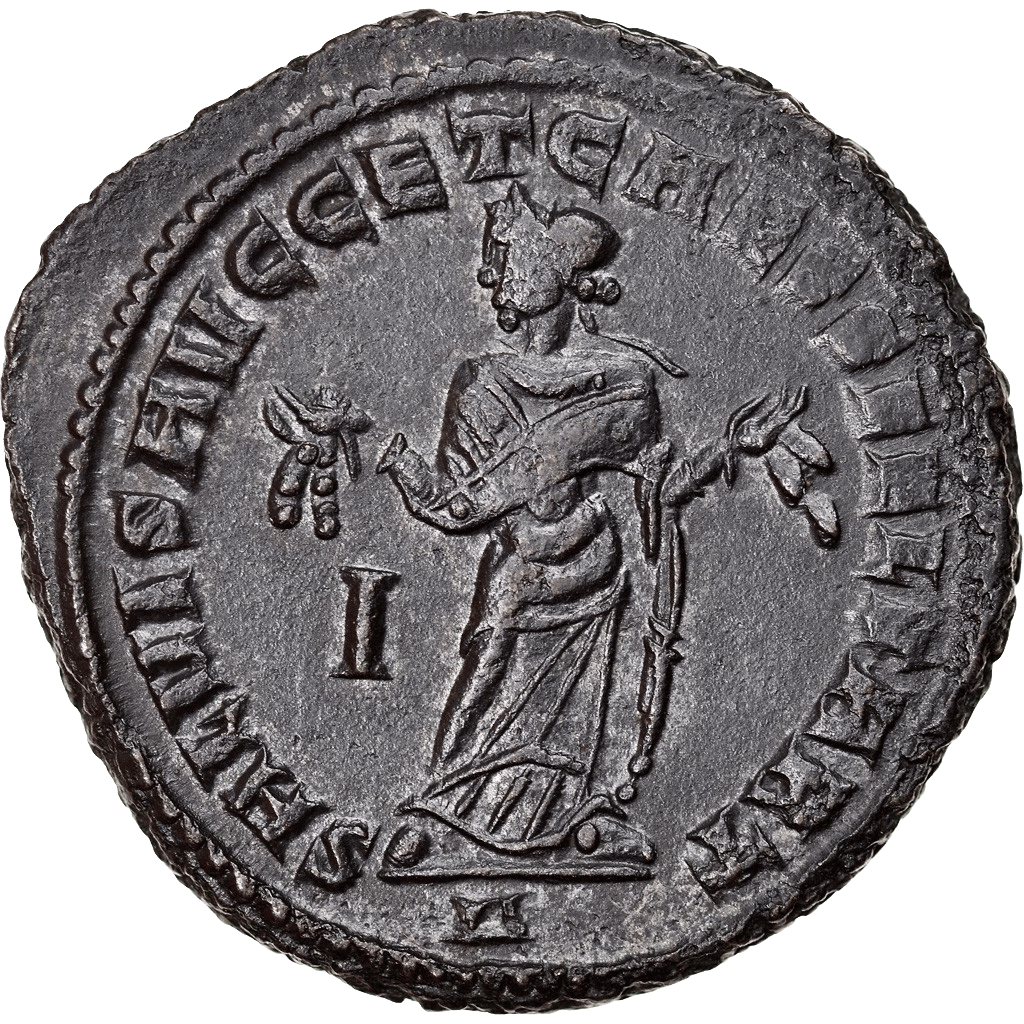
The picture shows an example. The piece you receive may differ in detail. On the reverse of the piece shown stands Moneta with scales and a cornucopia.
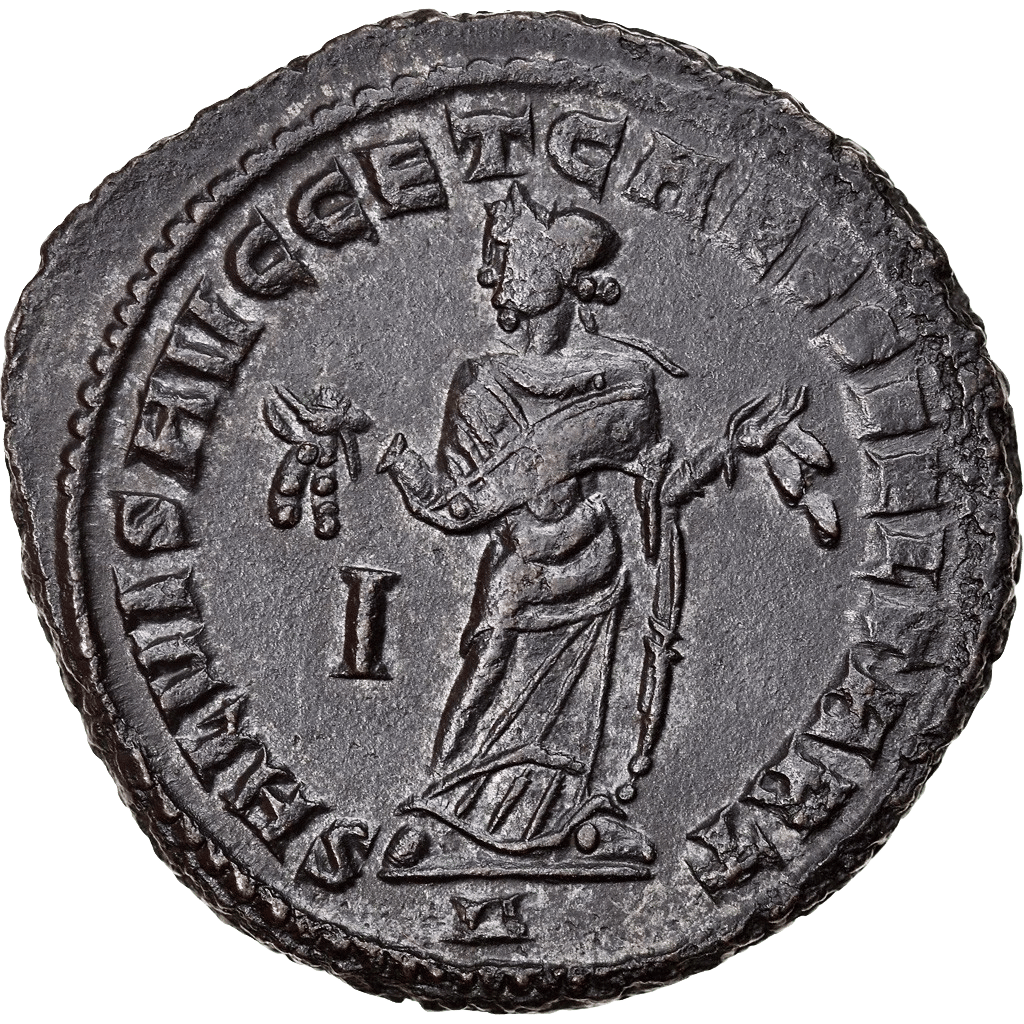
Under the lens
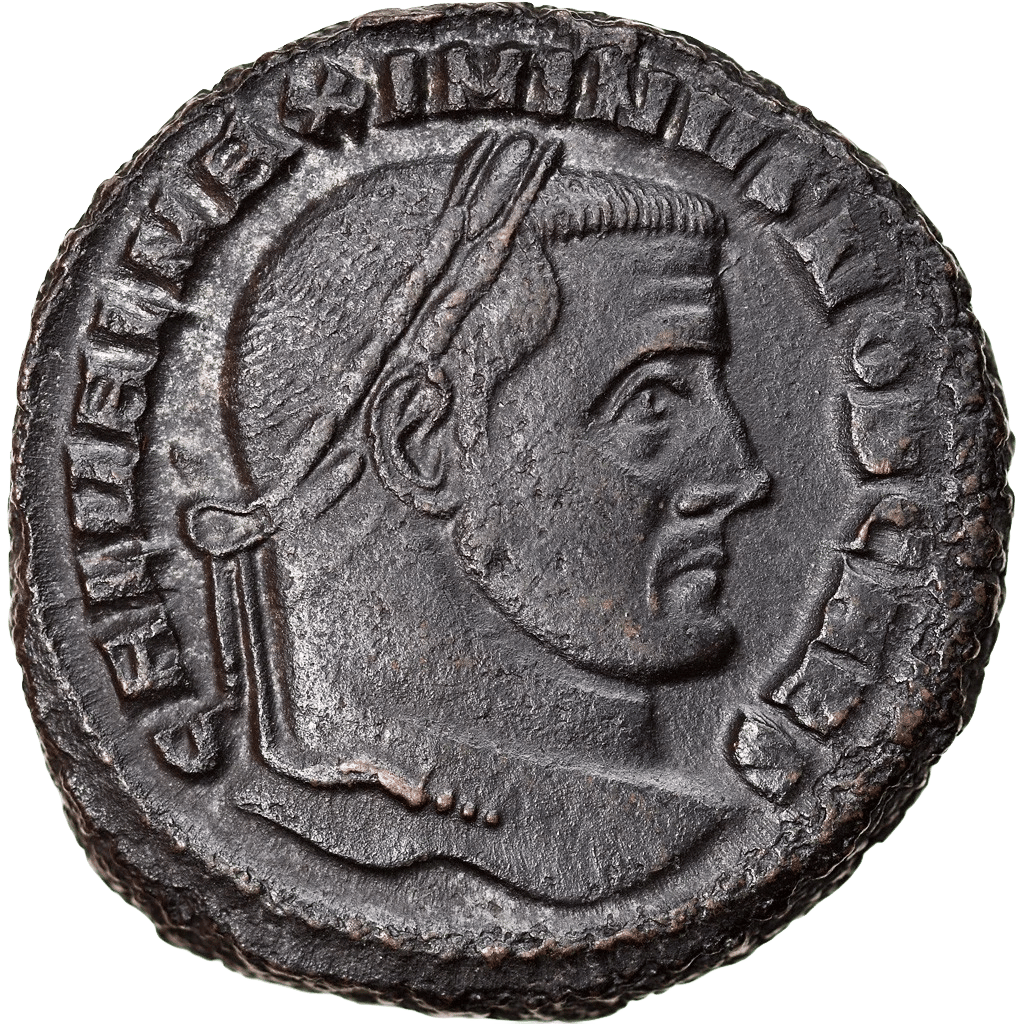
Large follis of Maximinus II up close: every detail about 1,700 years old.
At the same scale
Rome and its neighbours: coins side by side
The follis changed its size: about 27 mm early in the tetrarchy, 20 to 24 mm under Maximinus II, 20 mm under Constantine and his sons, 28 mm under Justinian.
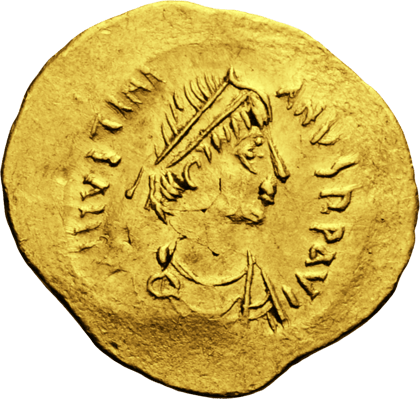 TremissisJustinian I
16 mm
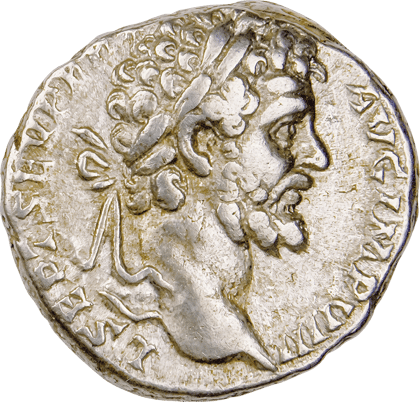 DenariusSeptimius Severus
c. 18 mm
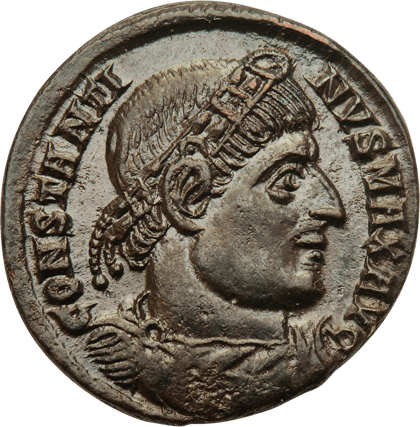 FollisConstantine I
20 mm
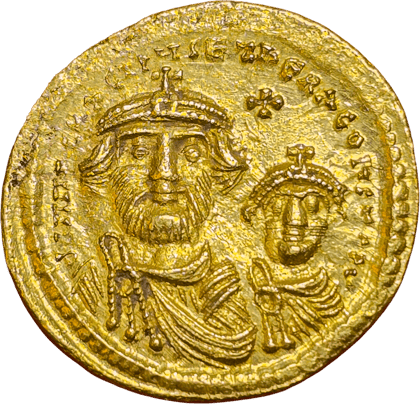 SolidusHeraclius
20 mm
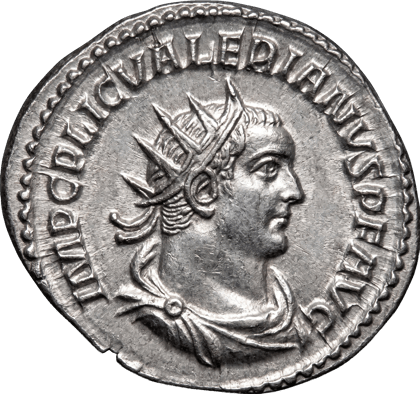 AntoninianusValerian I
21 to 23 mm
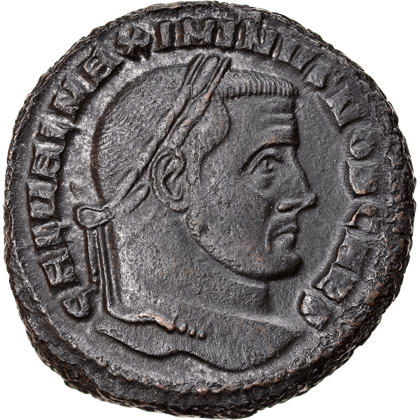 FollisMaximinus II
20 to 24 mmthis page
 1 eurofor comparison
23.25 mm
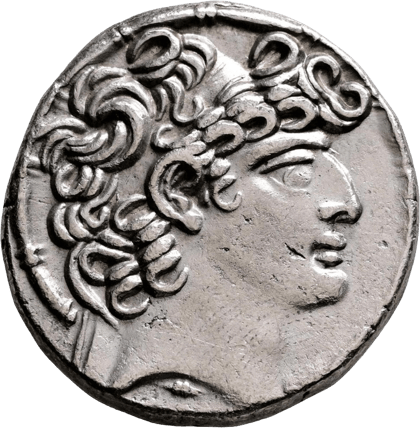 TetradrachmGaius Cassius
c. 27 mm
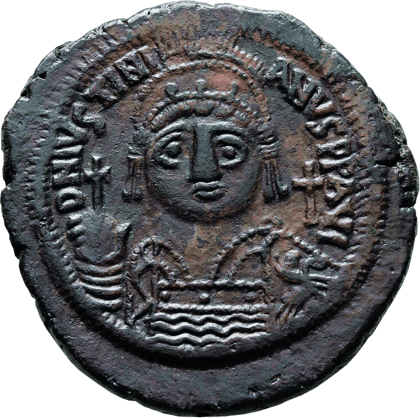 FollisJustinian I
28 mm
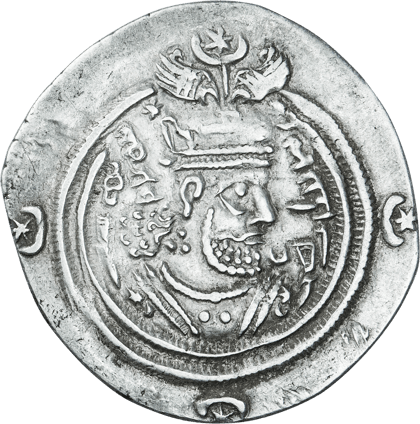 DrachmXusro II
30 mm
Where it belongs
45 originals from about 1,100 years
Each piece stands at the years of its ruler or of its type. The era of this piece is highlighted; choose another one to see its originals.
The tetrarchy AD 284 to 313 · 4 originals
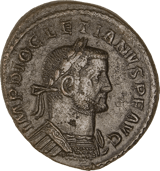 Large follis of DiocletianAD 284 to 305
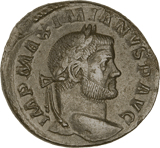 Large follis of MaximianAD 286 to 305
 Large follis of GaleriusAD 293 to 311
 Large follis of Maximinus IIAD 305 to 313this page

Keeping it
First things first: do not clean it.
The dark layer on bronze and the matte grey on silver are called patina. It has grown over centuries and protects the surface. Polishing it away takes that protection from the piece.
- Hold it by the edgeSkin oil can etch itself permanently into the surface. Take the piece by the rim between thumb and forefinger, over a soft surface.
- Store each piece on its own, and dryKeep each piece on its own in a dry place, in a capsule or an acid-free case. PVC sleeves do not belong there, they attack the surface.
- No agents, no polishing clothNo vinegar, no silver cloth, no ultrasound. According to the Bank of Canada Museum, almost any attempt at cleaning without a conservator leaves damage, mostly from abrasion.

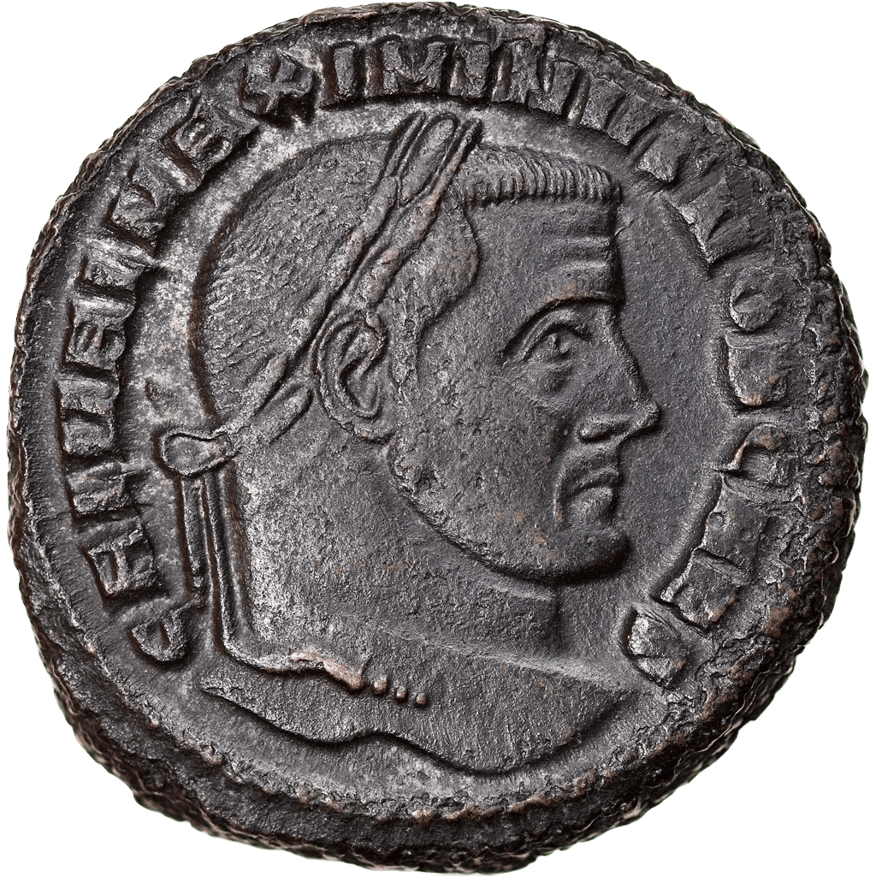
Struck about 1,700 years ago.
Maximinus II and his world are long gone. The piece has remained, with the traces of its circulation.
The Last Pharaoh Wore a Laurel Wreath
Over 1,700 years old. Hand-struck, passed from hand to hand through the centuries, at some point lost, buried, forgotten – and today found again. The Groß Follis of Emperor Maximinus II is not a restrike or a commemorative replica, but a genuine Roman coin from the era of the Tetrarchy. Whoever holds it in their hand holds money that was actually spent in the Roman Empire: in markets, in military camps, in port cities between Asia Minor and Egypt.
Maximinus II Daia – Tetrarch, Augustus, and the Last Pharaoh Attested in Hieroglyphs
Gaius Galerius Valerius Maximinus, known in numismatics mostly as Maximinus II or Maximinus Daia, came from no great family. He rose through the ranks of the Roman army, was adopted by his uncle Galerius, and was raised to the rank of Caesar in May 305. From 311 onward he ruled the eastern part of the empire as Augustus. He died in Tarsus in August 313, following his defeat against his rival Licinius.
The truly fascinating part, however, lies not in Roman history but in Egyptian history: Maximinus Daia is considered the last Roman emperor to be recognized as Pharaoh in Egyptian hieroglyphic inscriptions. With him, a line stretching back to predynastic times comes to an end. Three millennia of pharaonic rule close with the man whose portrait you see here. An emperor who, at the same time, attempted to strengthen the old cults against Christianity with a priesthood of his own – the ancient world fighting back once more, one last time.
The Follis: Rome's Answer to Inflation
Around 294 AD, as part of his currency reform, Emperor Diocletian introduced a new denomination intended to counteract debasement and inflation: the follis. It became the most important copper coin of the Roman Empire. It was struck at 1/32 of a Roman pound – roughly 10 grams – from bronze with a thin silver coating, the so-called silver wash. Its diameter initially ranged from 27 to 30 millimeters. Incidentally, the coin's ancient name is not firmly established; numismatists assume it was initially simply called Nummus.
It is precisely this silver wash that gives the coin its visual appeal. On many specimens, the raised areas still shimmer bright and silvery, while dark patina has gathered in the recesses. The name "Follis" (plural: Folles) means "bag" and presumably derives from sealed money bags containing a fixed, counted amount of coins. Over the course of the Tetrarchy, the weight and diameter of the folles were reduced several times – the pieces offered here date from this phase.
Key Technical Data at a Glance
Face value: Follis
Gross weight: approx. 7 g
Diameter: 20–24 mm
Material: Bronze or billon (copper alloy, historically with silver wash)
Year of issue: various, reign 305–313 AD
Country of origin: Roman Empire
Investment type: Coin – collector's item
Condition: circulated coin, condition varies
Series: History
Shipping: as insured value shipment
Obverse and Reverse: What You See on the Coin
The obverse shows the emperor in profile facing right, crowned with a laurel wreath, with short, finely combed hair and a hint of a beard. The laurel wreath is worked out with individual leaves and is held at the back of the neck by a ribbon with two curved ends. Below it, a strong neck with a straight neckline and a pronounced chin. The legend on the pictured specimen reads GAL VAL MAXIMINVS NOB CAES – Galerius Valerius Maximinus, Nobilissimus Caesar.
On the reverse of this particular piece, the legend SALVIS AVGG ET CAESS FEL KART appears: the city goddess of Carthage, standing, holding fruits in both hands, struck in Carthage. Other specimens bear different reverse types and mints – for example GENIO CAESARIS from Heraclea, GENIO AVGVSTI, or Jupiter types of the IOVI CONSERVATORI style. This variety is typical of the Tetrarchy and provides collectors with an additional incentive.
Condition: Signs of Circulation as a Mark of Authenticity
These pieces are circulated currency and bear corresponding traces: darker patina, individual centering, nicks, wear, and in some cases weaker areas of the legend. This is exactly what gives them their charm. Since the year of issue, mint, and reverse variant can vary, the specimen you receive will differ from the illustration – you receive an original, not a mass-produced item. We therefore ask for your understanding that the image shown in the shop is an example and may differ individually from the delivered item in terms of appearance and condition due to historical circumstances. Obverse and reverse designs may expressly vary.
An ancient coin is not a smooth, industrial product. The slightly irregular flan, the weak striking in certain areas, the small nick on the edge – these are the fingerprints of a workshop that closed its doors for the last time around 1,700 years ago.
Who This Groß Follis Is Suited For
Newcomers to ancient numismatics: a large, easily legible imperial portrait from the Roman Empire
Collectors of the Tetrarchy: fits alongside Diocletian, Maximianus, Constantius, Galerius, Licinius, and Constantinus
History enthusiasts: a tangible link to the end of pharaonic rule and to late antiquity
Lovers of genuine tangible assets: an original coin that can be held, turned over, and passed on – independent of any digital accounting system
Gift givers: a year in which this piece changes hands will be remembered
In Comparison: Follis, Denarius, and Antoninianus
For centuries, the denarius was Rome's silver backbone – small in diameter, with its silver content increasingly diluted over time. The antoninianus followed as a double denarius and likewise quickly lost fineness. The follis, by contrast, relies on format: a heavier flan, a more sculptural portrait, and a legend that is generally easier to read. Anyone wishing to display an imperial portrait from antiquity without reaching for a magnifying glass will do excellently with a Groß Follis. Silver denominations, meanwhile, score points with their precious metal content. Both paths have their appeal – and most well-developed collections combine them anyway.
History You Can Hold in Your Hand
Gold is humanity's oldest currency and has outlasted every paper currency. Coins like this follis tell the other half of this story: they show what happens when rulers tamper with the weight and content of their money. Diocletian's reform was an attempt to restore lost trust. The follis is the monument to that attempt – and thus far more than a piece of bronze. Secure an original from the reign of the last pharaoh while specimens in appealing circulated condition are still available.
Product image may differ from the actual product.
