





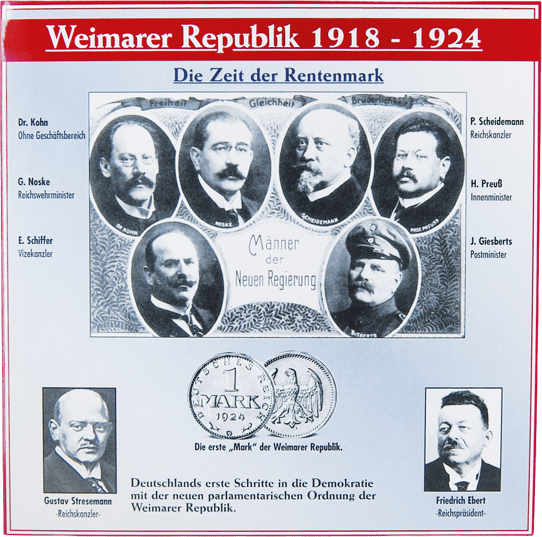


Coin Set of the Weimar Republic (1st Issue: 1918-1924)
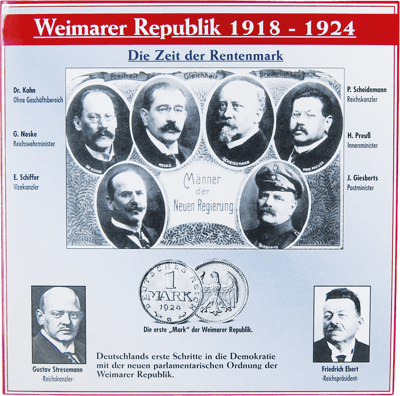












- Turning Point 1923: end of inflation
- Genuine Originals: once legal tender
- Blister Card: with certificate of authenticity
- Turning Point 1923The Rentenmark abruptly stopped hyperinflation in 1923
- Genuine OriginalsSix circulation coins from the Rentenpfennig to the 1924 Mark
- Blister CardThe card features Friedrich Ebert and Gustav Stresemann
 Price alert
  Share
Share
Originals from the Weimar Republic
Rentenpfennigs and a mark
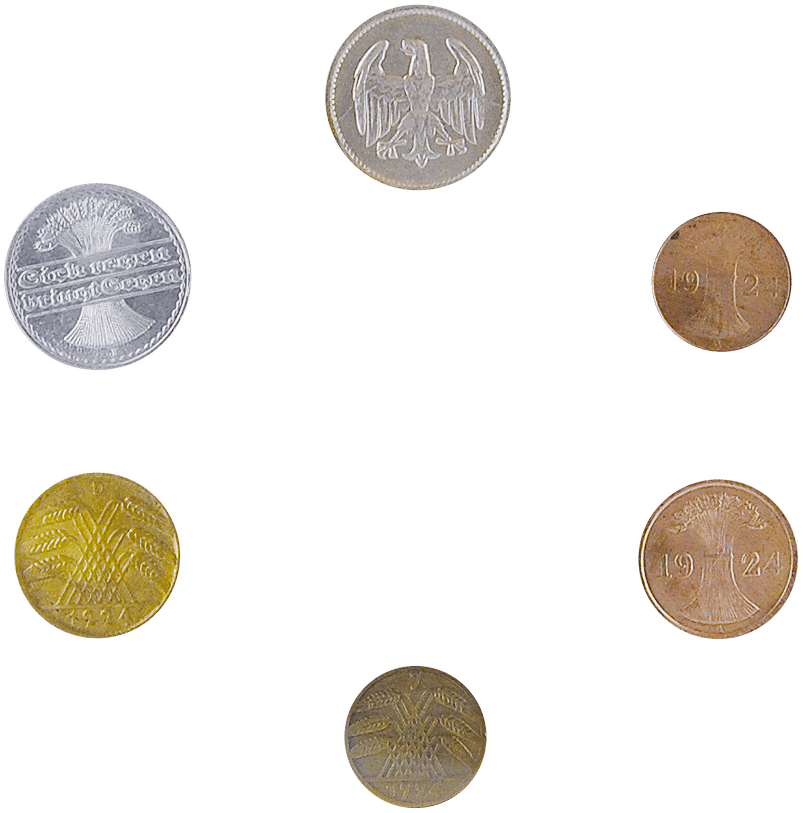
The Rentenmark of 100 Rentenpfennig existed from autumn 1923, the Reichsmark from October 1924. The set brings together six coins of the Weimar Republic on one card.
On the piece
What this set holds
The set holds six coins, among them Rentenpfennigs and a mark from the year 1924.

Rentenmark and Reichsmark
From the Rentenmark to the Reichsmark
In the autumn of 1923 the Rentenbank was founded. Its Rentenbank notes were issued in a new money:
“The unit of value of these Rentenbank notes is the Rentenmark, which is divided into 100 Rentenpfennig.”
15 October 1923
Decree on the founding of the Rentenbank.
8 November 1923
A decree allows coins of 1, 2, 5, 10 and 50 Rentenpfennig.
30 August 1924
The coinage act introduces the Reichsmark.
October 1924
The Reichsbank issues the Reichsmark alongside the Rentenmark, one to one.
June 1948
The Deutsche Mark replaces the Reichsmark.

Weimar commemorative coins
Three Reichsmark for an occasion
The Weimar Republic struck commemorative coins of 3 Reichsmark, in 1930 for instance for the 700th anniversary of the death of Walther von der Vogelweide.
The gold of the mark
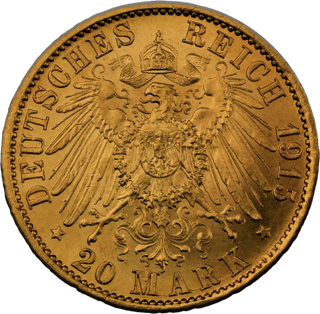
The gold of the German Empire
Twenty and ten marks in gold, 900/1,000: a twenty-mark piece weighs 7.96 grams, of which 7.17 grams is fine gold.
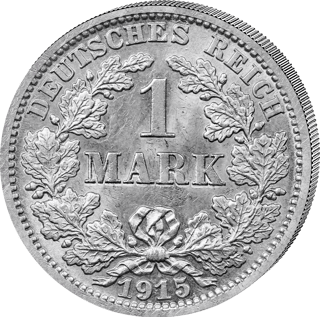
The mark in silver
The silver mark in the hand
A mark holds 5 grams of fine silver, 900/1,000, and measures 24 millimetres. No one had to accept silver coins for amounts over 20 marks.
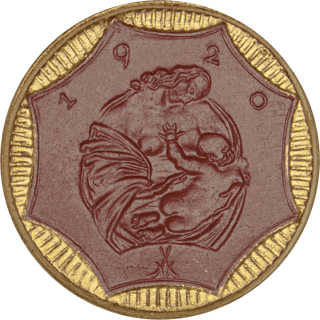
Emergency money
Emergency money in stoneware and from Hamburg
In 1921 Saxony issued emergency money of Meissen Böttger stoneware, and in August 1923 Hamburg issued its own emergency money.
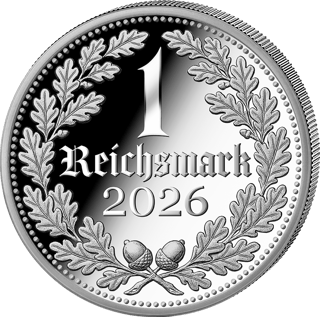
Our strikes
What our strikes take up
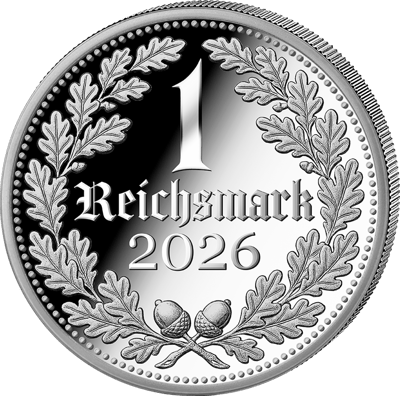
Our strikes bear the lettering 1 Reichsmark or 1 Mark in an oak wreath. They are newly struck, no Reichsmark of the past and no legal tender of the Reich.
At a glance
- Type
- Set of originals
- Era
- Weimar Republic
- Number of pieces
- 6 pieces
- Contents
- six coins of the Weimar Republic, among them Rentenpfennigs and a mark
- Packaging
- Blister card
Details from our product data and the strike.

Original and new strike
On the left 3 Reichsmark of 1925 with the value in an oak wreath, on the right our ounce, which bears the lettering 1 Reichsmark in an oak wreath.
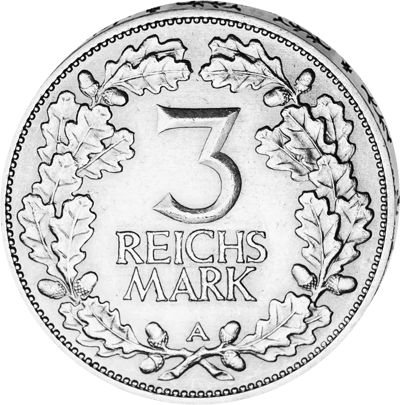
Coin Set of the Weimar Republic (1918–1924) – The Era of the Rentenmark
Six original circulation coins, a piece of German history you can hold in your hands: with this coin set of the Weimar Republic, you are holding genuine circulated coins from one of the most turbulent eras in our country's history. These coins were once legal tender, passed through countless hands – and today tell the story of the young German democracy and the currency that led the country out of hyperinflation.
What Makes This Coin Set So Special
The years following the First World War were marked by upheaval. In November 1918, the Weimar Republic was proclaimed as the first parliamentary democracy on German soil. A few years later came the great hyperinflation of 1923, during which paper money became virtually worthless. Only the introduction of the Rentenmark in November 1923 brought the currency devaluation to an abrupt halt – one Rentenmark was equivalent to one trillion paper marks. On 30 August 1924, the Reichsmark finally replaced the Rentenmark as the official means of payment.
This set captures precisely that transition. The smaller denominations bear the characteristic design of grain ears – a symbol that the new currency rested on real tangible assets and was winning back the trust of the population. It is the same timeless idea that has always underpinned precious metals: values you can touch outlast crises, while pure paper money comes and goes.
The Included Coins at a Glance
- 1 Rentenpfennig (Jäger 306) – copper/bronze, obverse with grain ears
- 2 Rentenpfennig (Jäger 307) – copper/bronze, grain ear design
- 5 Rentenpfennig (Jäger 308) – aluminium-bronze, shimmering gold-coloured
- 10 Rentenpfennig (Jäger 309) – aluminium-bronze, grain ear design
- 50 Rentenpfennig (Jäger 310) – aluminium-bronze, the largest pfennig piece in the set
- 1 Mark 1924 – featuring the distinctive Reichsadler (imperial eagle) on the reverse
These circulation coins were struck at the German mints of the time; the respective mint mark (such as "A" for Berlin or "F" for Stuttgart) reveals the issuing mint. The simple, powerful design featuring ears of grain and oak leaves is regarded by many collectors to this day as the typical face of the early Weimar Republic.
History Within Reach
The accompanying blister card pays tribute to the "men of the new government" surrounding Reich President Friedrich Ebert and Reich Chancellor Gustav Stresemann, under whose chancellorship the Rentenmark was introduced. It also recalls the era of emergency money (Notgeld), during which entire regions issued their own coins – the highest denomination was the famous 1-trillion-mark piece from the Province of Westphalia in 1923. In this way, the set becomes a compact history book that brings the politics, economics, and everyday life of these years of upheaval to life.
For Collectors and History Enthusiasts
As circulated coins, these pieces bear visible signs of wear in varying grades of preservation – and that is precisely what gives them their charm. Every nick, every patina tells of the journey through time and through the hands that once used these pieces. The set is ideally suited as an introduction to the manageable yet multifaceted collecting field of the Weimar Republic, as a gift with historical depth, or as a tangible piece of German monetary history.
Original coins from this period have been collected for decades and are sought after by numismatists as historical artefacts. Those who collect history will find it here in a particularly concentrated form: six originals, one theme, one era.
Precious metals and coins have preserved their appeal and significance over centuries, while paper currencies have come and gone – few sets illustrate this lesson of history as vividly as this one.
The Weimar Republic coin set is delivered in a protective blister card including a certificate of authenticity – carefully packaged and ready for your collection.
Product depiction may differ from the final product.
