





- Austrian Mint: since 1194
- Imperial design: with Franz Joseph
- High gold content: fineness 986/1000
- Austrian MintFrom the mint behind the famous Vienna Philharmonic
- Imperial designHis portrait and the double eagle of Austria-Hungary
- High gold contentA classic among gold coins, with 98.6 percent gold







- Austrian Mint: since 1194
- Imperial design: with Franz Joseph
- High gold content: fineness 986/1000
 Price alert
 Share

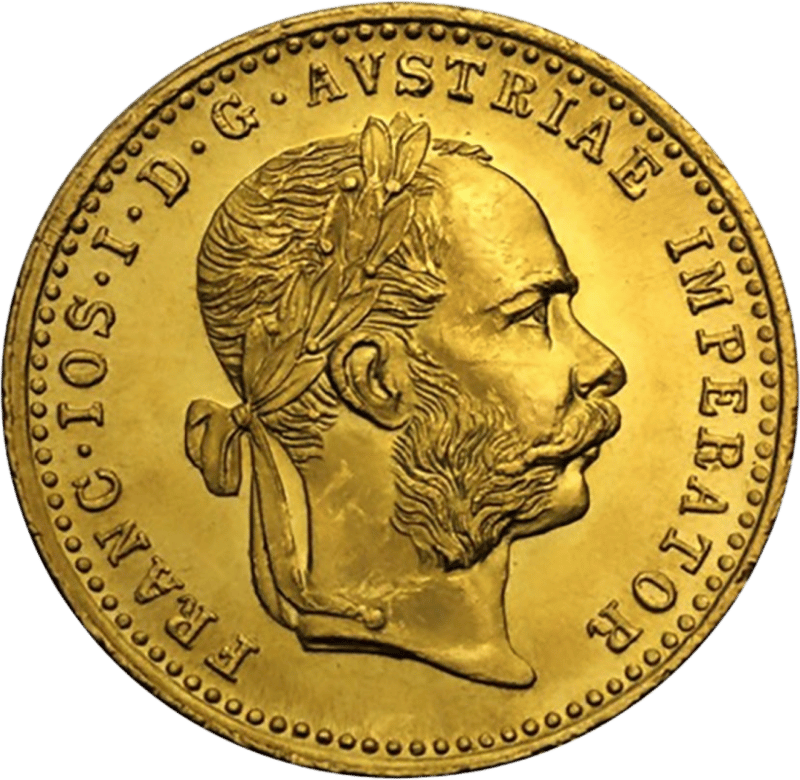
The gold of the Habsburgs · Ducats
The 1 Gold Ducat from Vienna.The emperor in his laurel wreath.
Franz Joseph I of the House of Habsburg reigned for almost 68 years. On the 1 Ducat he wears laurel, and on the reverse the double eagle keeps watch.
- Fine gold
- 3.44 g
- Fineness
- 986/1,000
- On the coin
- 1915
Franz Joseph I of the House of Habsburg reigned for almost 68 years. On the 1 Ducat he wears laurel, and on the reverse the double eagle keeps watch.
- Fine gold
- 3.44 g
- Fineness
- 986/1,000
- On the coin
- 1915
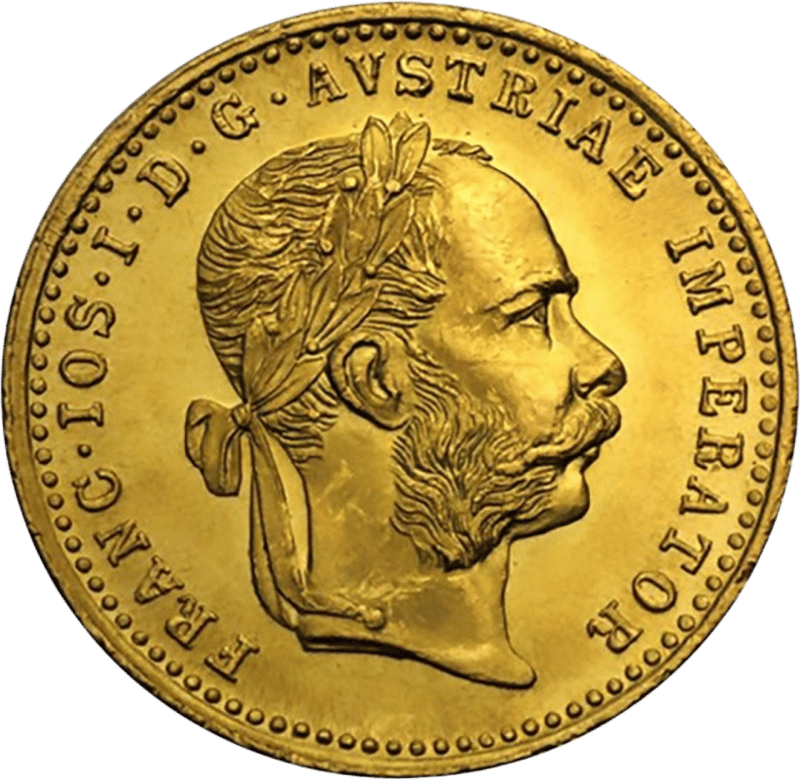
Up close
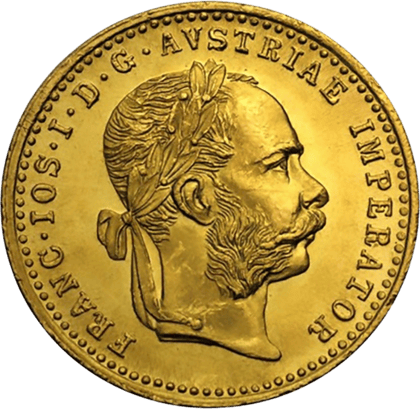
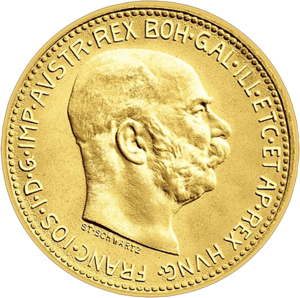
Up close on the 1 Ducat: laurel, ribbon and the emperor’s profile.
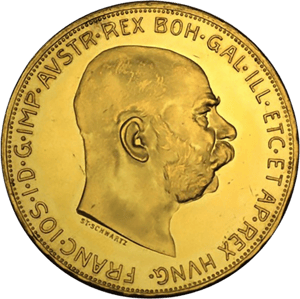
Franz Joseph I of the House of Habsburg‑Lorraine was Emperor of Austria from 1848 to 1916. Around him runs FRANC·IOS·I·D·G·AVSTRIAE IMPERATOR.

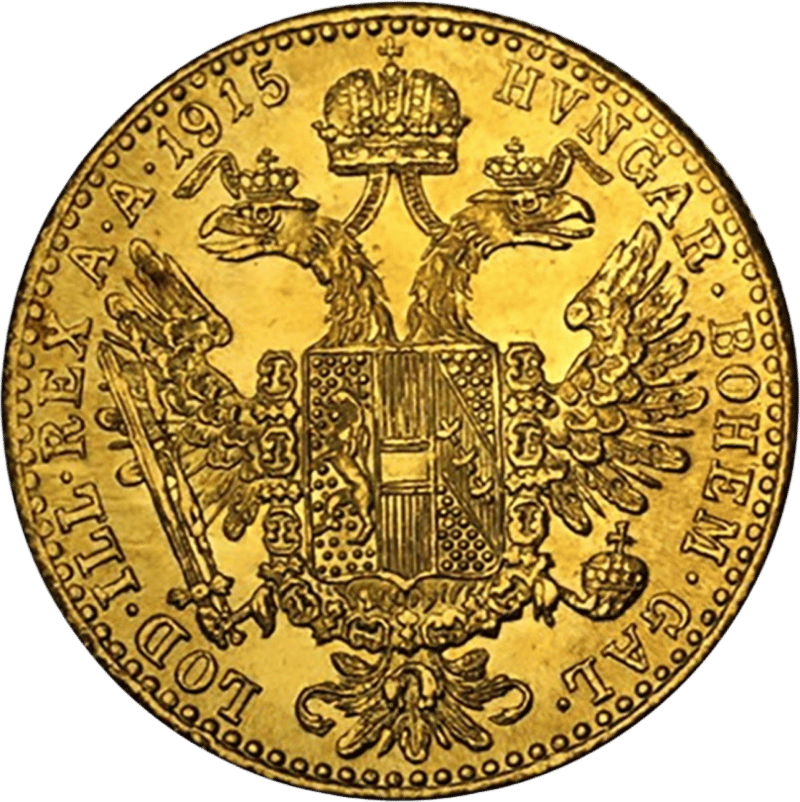
The reverse
The 1 Ducat turns: the double eagle with sword and orb.
The double eagle carries a sword and an orb, and around it run the emperor’s titles as King of Hungary, Bohemia and further lands. The coin reads 1915.
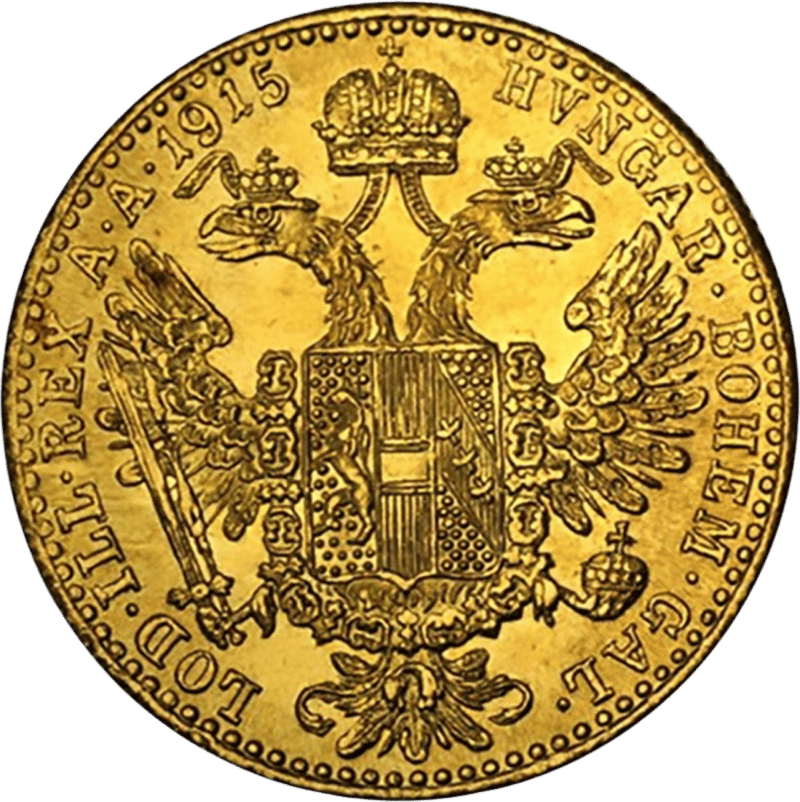
The reverse up close
A coat of arms in gold: eagle, breast shield, sword and orb, with the emperor’s titles all around.

Ducats since the 16th century
1 and 4 Ducats.Gold that travelled as a trade coin until 1915.
The ducat came to Austria from medieval Italy. Its design with the emperor and the double eagle dates from 1872, and it served as a trade coin until 1915.
- 16th c.The ducat is struck in Austria for the first time in the early 16th century.
- 1857The ducat loses its status as a means of payment and stays in use as a trade coin.
- 1872The design of these ducats is struck for the first time.
- 1915Until this year the ducat serves as a trade coin. The coin bears exactly this year.

The mint
1 Ducat from Vienna.Struck on the Heumarkt, in the heart of the city.
The mint building on the Heumarkt has stood since 1838. The Münze Österreich is still based here today, and here, in the heart of Vienna, its coins are made.
- 1733Since this year Vienna has had the mint’s engraving academy.
- 1838The mint building on the Heumarkt is completed.
- 1918Since then Vienna has been Austria’s only mint.
All 7 on the shelf
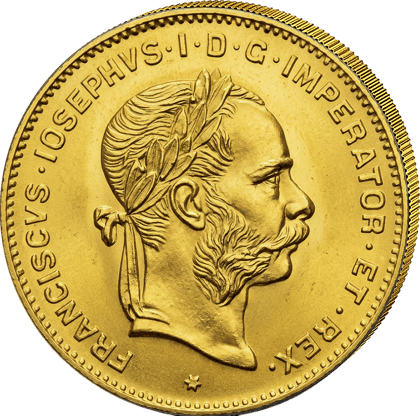
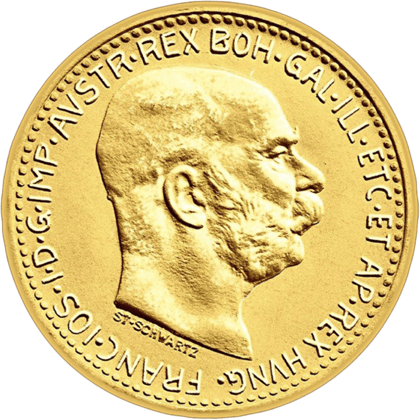
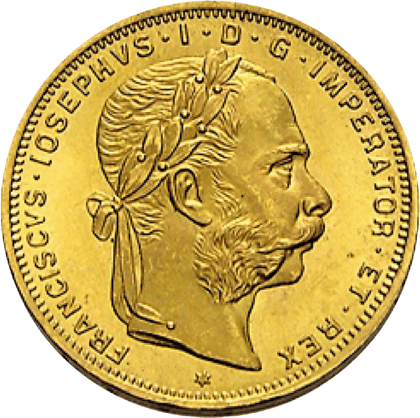
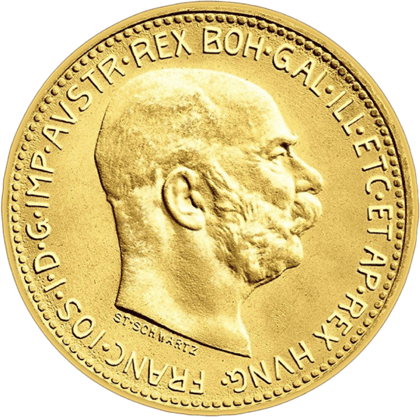
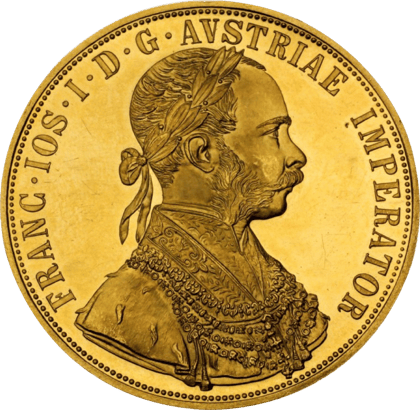
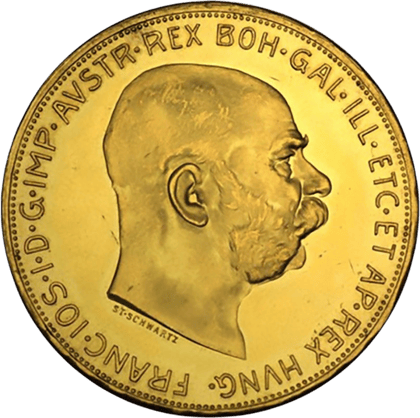
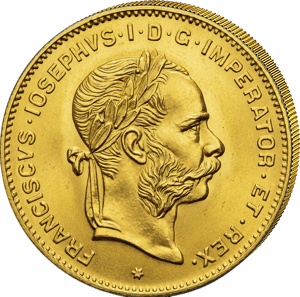
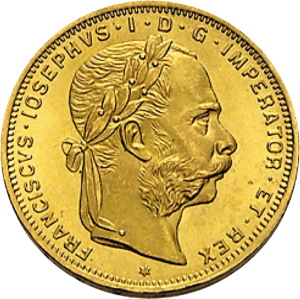
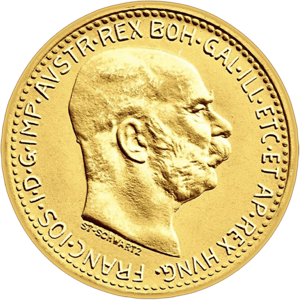
From 4 Florin to 100 Kronen.7 gold coins of the emperor in a row.
In true proportion, by the dimensions of the Münze Österreich, with more fine gold from left to right.
The fact sheet
1 Ducat in gold, measure by measure.
- Face value
- 1 Ducat
- Year on the coin
- 1915
- Obverse
- Emperor Franz Joseph I with laurel wreath
- Reverse
- Double eagle with sword and orb
- Mint
- Münze Österreich, Vienna
- Country
- Austria
- Packaging
- Coin capsule
Dimensions and weights as stated by the Münze Österreich. The year is the one that stands on the coin.
The family
The gold of the Habsburgs.7 coins with Franz Joseph I, struck in Vienna.
Ducats, florin and kronen: 3 families with the emperor’s portrait, all from Vienna.
Ducats
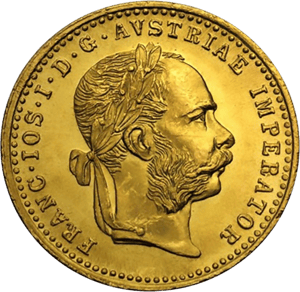 1 Ducat3.44 g fine goldThis page
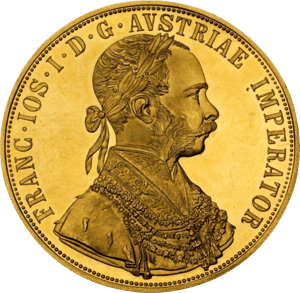 4 Ducats13.77 g fine gold

The gold of the Habsburgs
Almost 68 years of empire, held in 1 Gold Ducat.
The emperor in front, the double eagle behind, gold 986/1,000 from Vienna.
1 Gold Ducat New Minting: fine ducat gold in a small denomination
- Design: Emperor Franz Joseph I in profile, with a wreath in his hair and the Latin inscription AVSTRIAE IMPERATOR, meaning Emperor of Austria.
- Material / Fineness: Gold with a high fineness of 986/1,000, which equals 3.44 g of pure precious metal.
- Manufacturer: The Austrian Mint issues the historic ducat as a new minting.
- Crisis provisioning: A small unit that can be used well as a means of exchange in an emergency.
- Value preservation: A tangible asset that cannot be multiplied by decree.
For centuries, the ducat was one of Europe's most well-known gold coins. With the 1 Gold Ducat New Minting, the Austrian Mint revives this tradition in its classic form: made of almost pure gold. For investors who want to secure their wealth in manageable steps, it is an ideal building block. Anyone who takes pleasure in history also holds a piece of imperial Austria in their hand.
Almost pure gold as a ducat
With a fineness of 986/1,000, the ducat consists almost entirely of gold. For a coin with a historical model, this is a remarkably high value, as many classic gold coins were minted at 900/1,000. The fine weight is 3.44 g. This results in a coin that is convenient to store. As circulated goods in bank-standard condition, each piece may show minor signs of wear, which does not affect the fineness.
The portrait of the Emperor
The obverse shows Emperor Franz Joseph I in profile, his hair adorned with a wreath. The Latin words AVSTRIAE IMPERATOR identify him as Emperor of Austria, and a row of fine dots lines the edge. Franz Joseph I reigned for almost seven decades, one of the longest reigns in European history. The reverse features the crowned double eagle, the heraldic animal of the empire.
Small denomination for uncertain times
The advantage of gold coins in this denomination becomes especially apparent in times of crisis. Anyone who only wants to exchange a small amount in an emergency does not give up a large value all at once with a single ducat. The coin can be used flexibly, is easy to transport, and can be stored discreetly. As a building block for crisis protection, it sensibly complements larger coins and bars, as several small units keep you flexible.
Gold against the loss of purchasing power
Paper money can be printed in any quantity, while gold, on the other hand, is scarce and cannot be multiplied at the push of a button. That is why this precious metal has been considered a reliable store of value for thousands of years, and central banks are among the largest gold holders in the world. As an inflation hedge, the ducat helps you preserve savings over long periods. For private investors in Germany, profits from the sale are tax-free after a holding period of one year.
The most important facts at a glance
- Face value: 1 ducat
- Fine weight: 3.44 g
- Fineness: 986/1,000
- Manufacturer: Austrian Mint
- Country of origin: Austria
- Condition: Circulated goods in bank-standard condition
Sometimes it is precisely the ducat that offers the most flexibility in difficult times.
Secure a piece of Austrian coin tradition made of almost pure gold with the 1 Gold Ducat New Minting, at Kettner Edelmetalle.
Product image may differ from the actual product.
