





1 oz Silver Prehistoric Life II Tupandactylus 2026 (Mintage: 10,000)
- Secure shipping: 100% insured & anonymous delivery
- Kettner Bullion: Already over 300,000 satisfied customers
- Secure shipping100% insured & anonymous delivery
- Kettner BullionAlready over 300,000 satisfied customers







- Secure shipping: 100% insured & anonymous delivery
- Kettner Bullion: Already over 300,000 satisfied customers
 Price alert
 Share

Tupandactylus
A crest taller than its whole head.The Tupandactylus 2026 in 1 oz of silver.
1 ounce of silver, in brilliant uncirculated quality, issuing country Democratic Republic of the Congo. Tupandactylus lived about 112 million years ago in what is now Brazil.
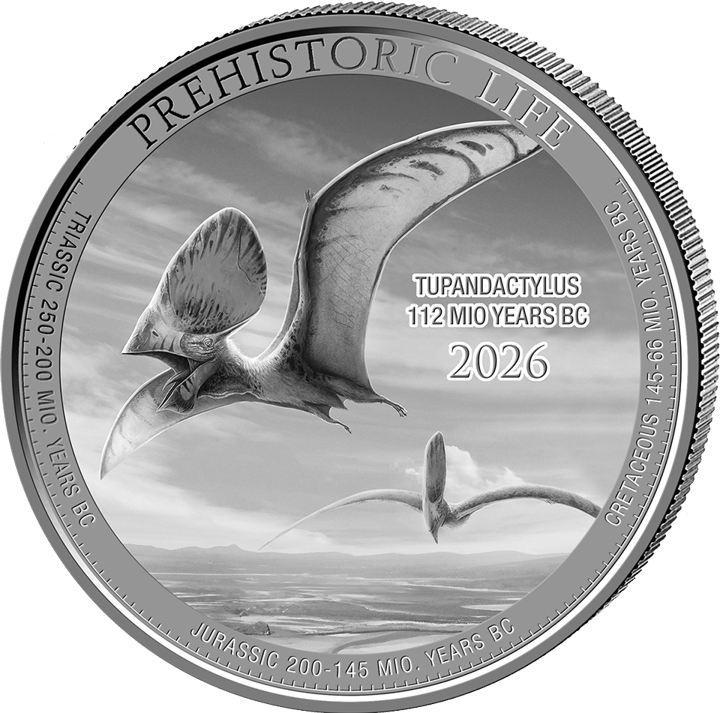
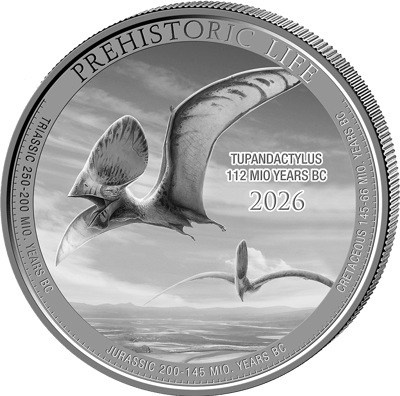
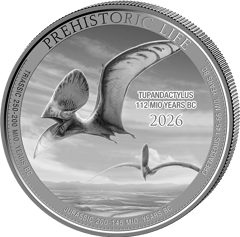
Tupandactylus on 1 ounce of silver, reverse, image
1 ounce of silver, in brilliant uncirculated quality, issuing country Democratic Republic of the Congo. Tupandactylus lived about 112 million years ago in what is now Brazil.

From the rock
Brazil’s limestone kept the crest that the coin shows.
Tupandactylus comes from the Crato Formation in north-eastern Brazil, finely layered limestone in which even soft tissue has survived. Its crest was partly bone, partly soft tissue. In the most complete skeleton known, it rises more than 5 times as high as the skull.
This skeleton lies in 6 limestone slabs that fit together exactly along straight cuts. That is how quarrymen there cut paving stones.
Source: Beccari et al., PLOS ONE, 2021
The timeline
From the Devonian to the last Ice Age
Each animal stands in its geological period. The sections show the order, not the duration.
Devonian
about 420 to 359 million years ago
 DunkleosteusArmoured fish
Carboniferous
about 359 to 299 million years ago
Permian
about 299 to 252 million years ago
Triassic
about 252 to 201 million years ago
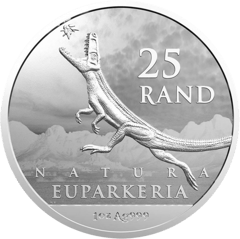 ArchosaursAnimal group
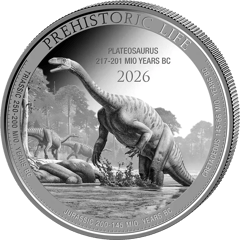 PlateosaurusDinosaur
Jurassic
about 201 to 143 million years ago
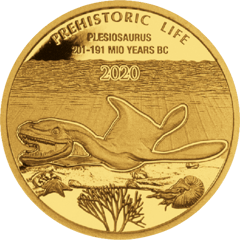 PlesiosaurusMarine reptile
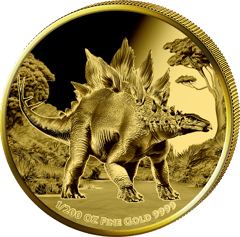 StegosaurusDinosaur
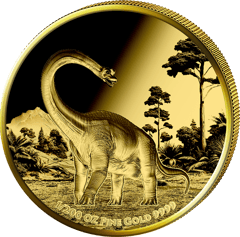 BrachiosaurusDinosaur
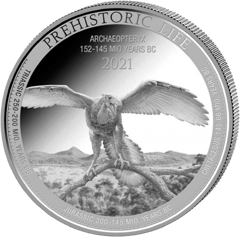 ArchaeopteryxEarly bird
Cretaceous
about 143 to 66 million years ago
 TupandactylusPterosaur
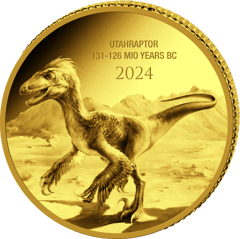 UtahraptorDinosaur
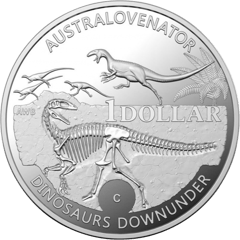 AustralovenatorDinosaur
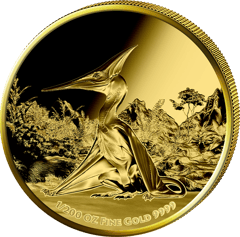 PteranodonPterosaur
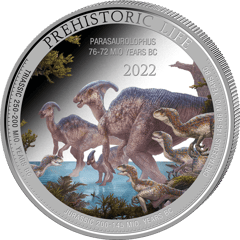 ParasaurolophusDinosaur
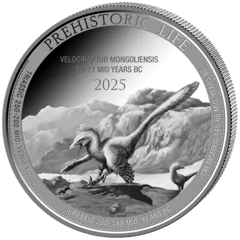 VelociraptorDinosaur
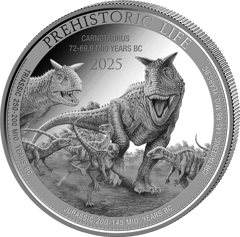 CarnotaurusDinosaur
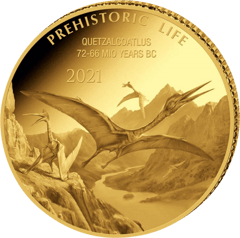 QuetzalcoatlusPterosaur
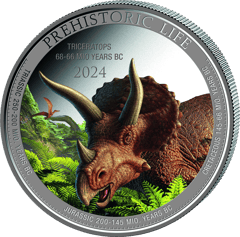 TriceratopsDinosaur
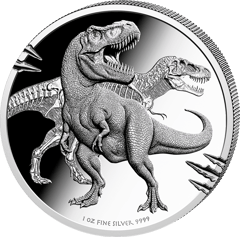 T. rexDinosaur
- The age of the dinosaurs ends 66 million years ago.
Palaeogene
66 to about 23 million years ago
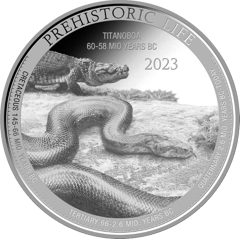 TitanoboaSnake
Neogene
about 23 to 2.6 million years ago
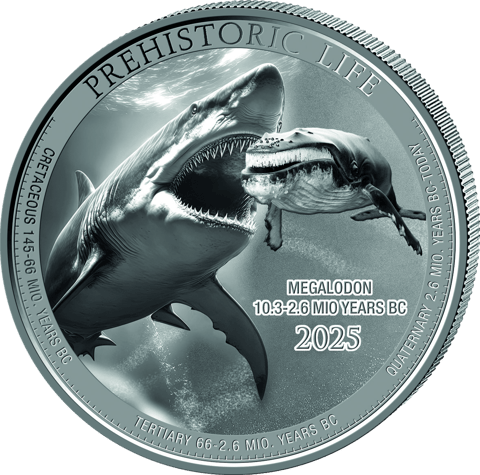 MegalodonShark
- The human genus begins about 2.8 million years ago.
Pleistocene
about 2.6 million to 11,700 years ago
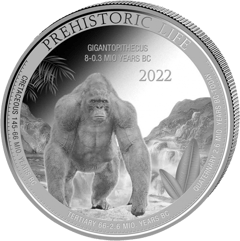 GigantopithecusGreat ape
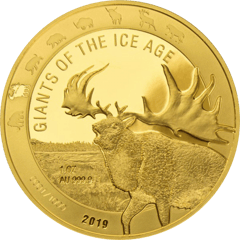 Giant deerMammal
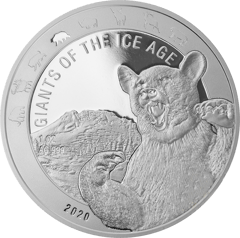 Cave bearMammal
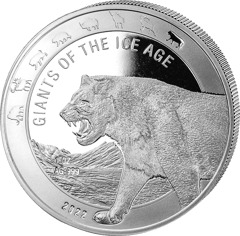 Cave lionMammal
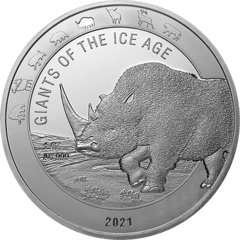 Woolly rhinocerosMammal
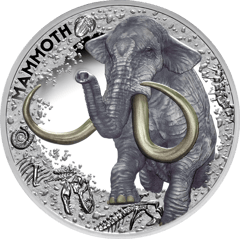 MammothMammal
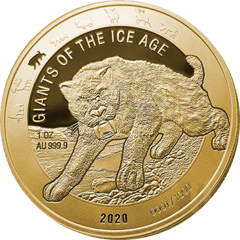 Sabre-toothed catMammal
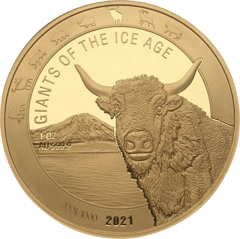 AurochsMammal
- Homo sapiens has existed for about 300,000 years.
- People enter the Chauvet Cave about 36,500 years ago.
Not to scale. Dates according to the International Commission on Stratigraphy, rounded.
The coin
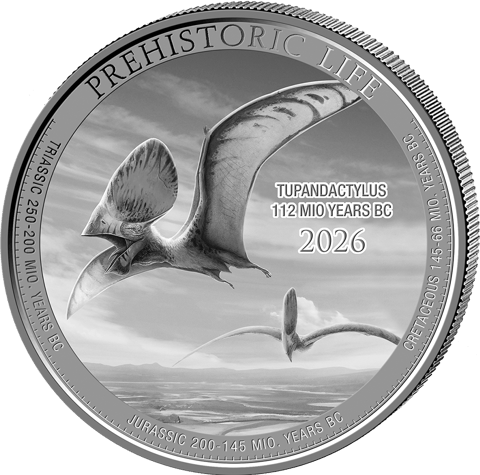
The Tupandactylus 2026: 2 pterosaurs over a wide plain.
On the reverse, 2 Tupandactylus fly over a wide plain crossed by streams, with hills on the horizon. The animal in front carries a tall crest and opens its beak. On the right of the field stand TUPANDACTYLUS, 112 MIO YEARS BC and 2026.
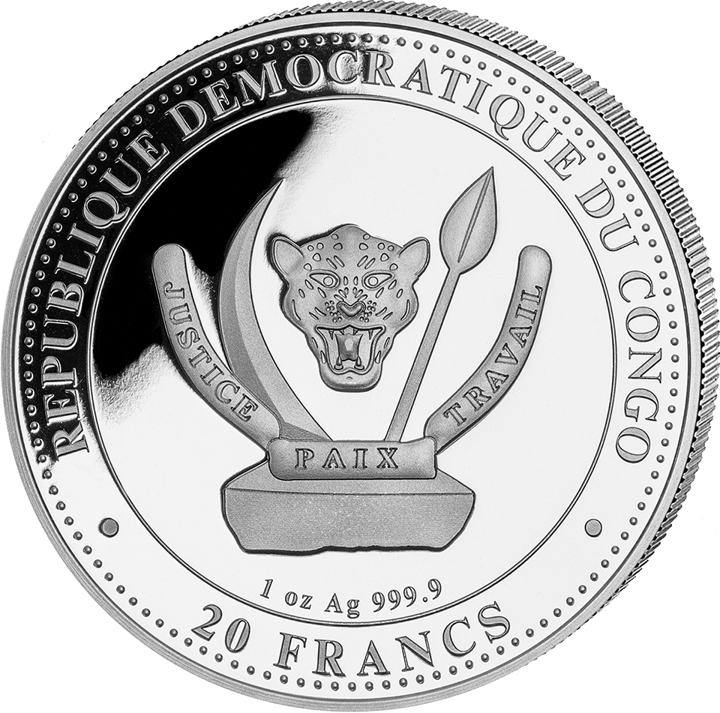
On the silver coins a timeline of the geological periods runs around the rim, and the obverse bears the coat of arms of the Democratic Republic of the Congo.
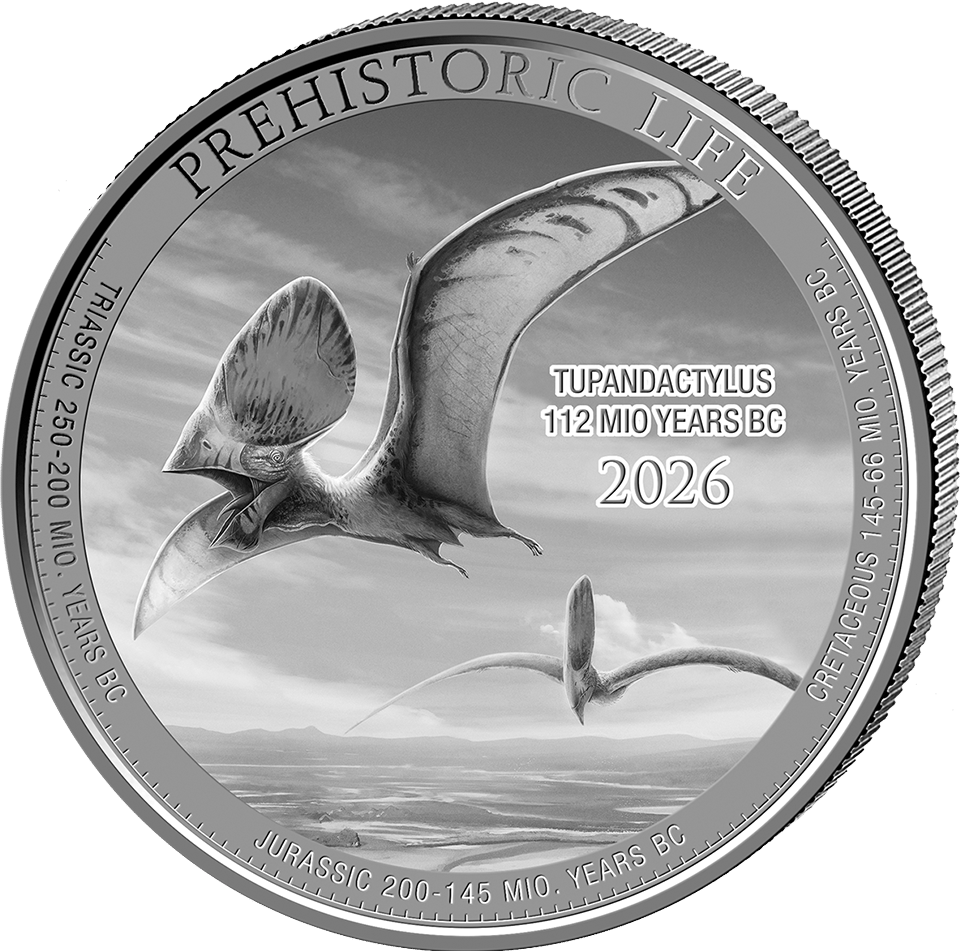
CrestThe crest of Tupandactylus
InscriptionTUPANDACTYLUS, 112 MIO YEARS BC
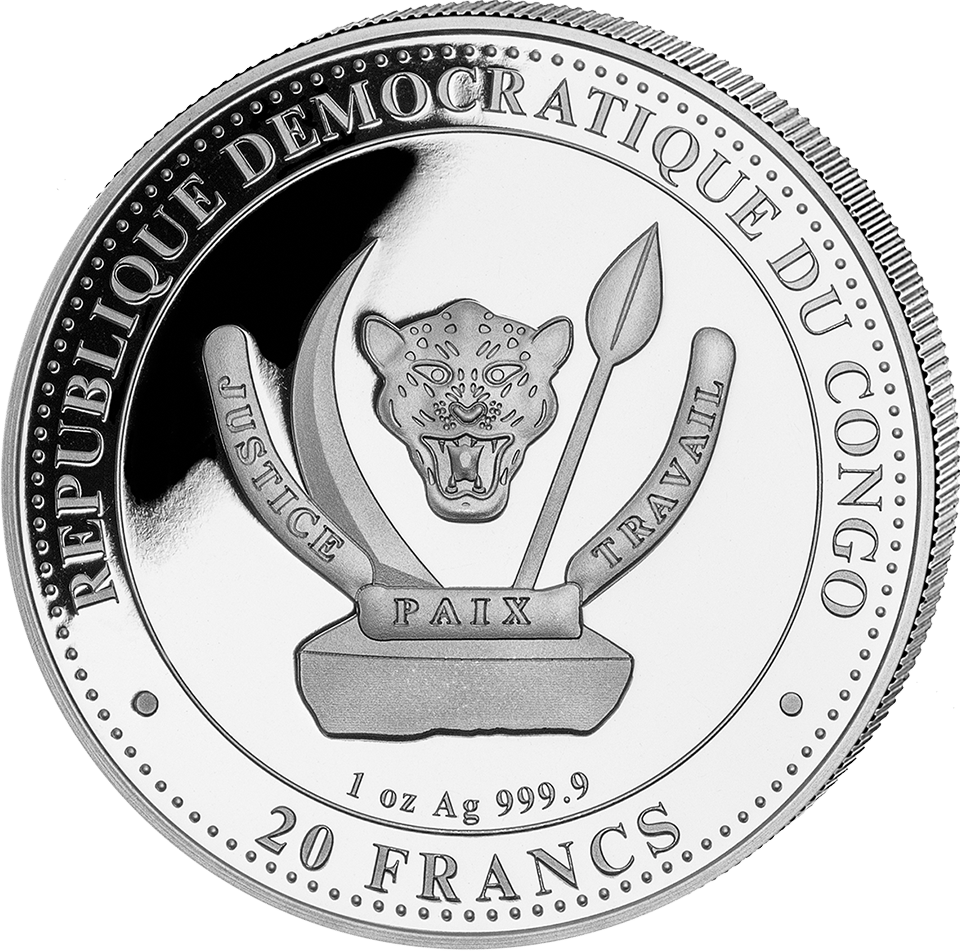
Coat of armsCoat of arms of the DR Congo
Face valueThe face value
The image up close
At a glance
- Issuing country
- Democratic Republic of the Congo
- Face value
- 20 francs
- Metal
- silver
- Weight
- 1 ounce
- Diameter
- 38.6 mm
- Quality
- Brilliant uncirculated
- Fineness
- 999.9/1,000
- Mintage
- 10,000 pieces
- Year
- 2026

From the limestone of Brazil into the light: the Tupandactylus 2026 in 1 ounce of silver.
Prehistoric Life II Tupandactylus 2026: The Pterosaur with the Giant Crest
- Strictly limited: worldwide mintage of only 10,000 pieces
- Growth opportunities: attractive appreciation potential thanks to the consistent limitation
- Coveted rarity: new design in the popular Prehistoric Life II series from the Democratic Republic of the Congo
- Highest purity: one troy ounce of fine silver 999.9/1,000 in Brilliant Uncirculated (BU)
- Two worlds in one coin: tangible investment silver and collector's item in one
A skull crest taller than the rest of the head put together. Wings that glide silently over a prehistoric lagoon. With the Tupandactylus, the Prehistoric Life II series brings one of the most spectacular pterosaurs of all time onto a coin – making this collector's coin a true highlight for anyone who loves prehistoric designs. Struck from a full troy ounce of silver with a fineness of 999.9/1,000, it combines tangible material value with a very low mintage.
Tupandactylus: A Contemporary of the Dinosaurs in the Sky
Strictly speaking, the Tupandactylus was not a dinosaur but a pterosaur. This flying reptile ruled the skies around 112 million years ago, during the Early Cretaceous, while dinosaurs dominated the ground below. Its fossils come from the famous Crato Formation in northeastern Brazil. Its name roughly translates to "finger of Tupã," named after the Tupi thunder god. And the toothless tapejarid's trademark? A massive, sail-like head crest, partly made of soft tissue, likely used primarily for display.
This very crest is impressively brought to life in the design. In the foreground, a Tupandactylus soars with its wings fully spread, while a fellow creature glides across a vast waterscape beneath a cloudy sky in the background. To the right are the inscriptions "TUPANDACTYLUS," "112 MIO YEARS BC," and the year of issue 2026. At the top, the series title "PREHISTORIC LIFE" is displayed, while the rim names the three major geological eras: Triassic (250–200 million years ago), Jurassic (200–145 million years ago), and Cretaceous (145–66 million years ago).
The Value Side: The National Coat of Arms of the Congo
The other side depicts the coat of arms of the Democratic Republic of the Congo: a leopard's head between an elephant tusk and a spear, resting on a stone base. The ribbons bear the motto "JUSTICE – PAIX – TRAVAIL." Around the edge reads "REPUBLIQUE DEMOCRATIQUE DU CONGO," below which is the inscription "1 oz Ag 999.9" and the face value of 20 Francs. A fine beaded border frames the design.
The Prehistoric Life Series: Prehistoric Times to Collect
Few series of African coins have won as many fans in recent years. The first Prehistoric Life series produced twelve issues, including the Woolly Mammoth, and concluded in 2023 with the Stegosaurus as its finale. Since 2024, Prehistoric Life II has continued the success story: the Triceratops, Suchomimus, and Utahraptor marked the beginning, followed by the Carnotaurus, Megalodon, and Velociraptor, and most recently the Plateosaurus from the Triassic. Now the Tupandactylus spreads its wings. Anyone who completes the series year after year builds a collection whose appeal grows with every new issue. The sister series World's Wildlife from the Congo is similarly sought after, by the way.
With a mintage of just 10,000 pieces worldwide, the Tupandactylus 2026 is a rarity that delights lovers of prehistoric designs and silver investors alike.
Technical Data at a Glance
- Country: Democratic Republic of the Congo
- Series: Prehistoric Life II
- Design: Tupandactylus (pterosaur)
- Year of issue: 2026
- Precious metal: Silver
- Fineness: 999.9/1,000
- Fine weight: 1 oz (31.1 g)
- Diameter: 38.60 mm
- Face value: 20 Francs
- Condition: Brilliant Uncirculated (BU)
- Edge: reeded
- Mintage: 10,000 pieces
- Manufacturer: Bayerisches Hauptmünzamt
- Packaging: coin capsule
Bullion or Collector's Coin? An Honest Comparison
Classic bullion coins such as the Maple Leaf or the Vienna Philharmonic are minted without a fixed mintage and are priced closer to pure material value. They are the first choice when weight alone is the priority. The Tupandactylus plays in a different league. Its premium over standard coins lies in its richly detailed design, a fixed limitation, and its membership in a sought-after series. The colorized variants in the series are usually issued in even smaller numbers but come at a significantly higher price. The Brilliant Uncirculated edition remains more accessible and is ideal for getting started or adding to an existing collection.
Because collectors worldwide compete for a limited number of pieces, this coin offers high appreciation potential. Once minting is complete, no further examples will be produced.
Why Silver? A Precious Metal with History and a Future
For thousands of years, this white metal has served as money, a medium of exchange, and a symbol of prosperity. Ancient drachmas, medieval thalers, silver dollars: hardly any material has shaped the history of money as much as silver. Unlike paper money, whose value rests solely on trust in states and central banks, silver carries an intrinsic, physical value. It is durable, retains its properties across generations, is traded worldwide, and can quickly be converted back into cash.
Add to this robust industrial demand. Electronics, photovoltaics, and medical technology all require this metal, and new technologies are constantly opening up further applications. This is matched by a limited supply – a combination that points to long-term value stability. That is why many investors consider silver coins a proven inflation hedge and a reliable safeguard in times of political and economic turmoil, as part of a broader crisis protection strategy.
- Tax advantage: In Germany, profits from the sale are generally tax-free after a holding period of at least one year.
- Affordable: Compared to gold, silver is easily accessible even with a smaller budget.
- Value for generations: ideal for long-term planning and for passing on to children and grandchildren.
Conclusion: Prehistoric Fascination Meets Fine Silver
The 1 oz Tupandactylus 2026 is more than an ordinary silver coin. It is a tangible piece of Earth's history, struck in pure fine silver and safely preserved in a coin capsule. For collectors of the Prehistoric Life series, it is a must-have; for investors, it is an appealing addition to a precious metals portfolio. Secure your own example of this limited edition while the small mintage is still available.
Product image may differ from the actual product.
