





- Aztec calendar: nicknamed Azteca
- Real history: from 1917 to 1949
- 15 g fine gold: fineness 900/1000
- Aztec calendarThe Aztec calendar stone graces the obverse
- Real historyOnce circulating money in Mexico, no longer minted today
- 15 g fine goldIts inscription states 15 grams of pure gold










- Aztec calendar: nicknamed Azteca
- Real history: from 1917 to 1949
- 15 g fine gold: fineness 900/1000
 Price alert
 Share
20 Mexican Peso Centenario Gold: 15 g of fine gold with the eagle of Mexico
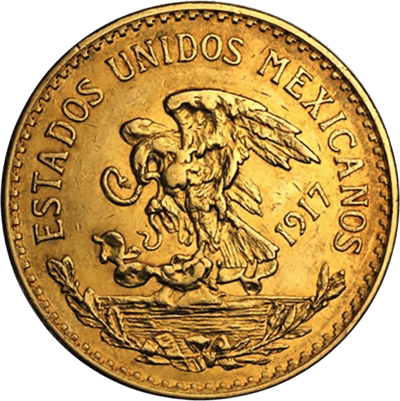
- Design: The coat of arms of Mexico, an eagle on a cactus with a snake in its beak, accompanied by the inscription ESTADOS UNIDOS MEXICANOS.
- Material / fineness: Gold with a fineness of 900/1,000; the coin contains 15 g of fine gold.
- Manufacturer: Struck by the Casa de Moneda de México, the country's mint.
- Format: 27.5 mm in diameter with a reeded edge, pleasant to hold and space-saving to store.
- Tangible asset: Its value does not depend on any promise to pay; it lies in the precious metal itself.
In Mexico, even the national coat of arms tells a story, and on the 20 Mexican Peso Centenario Gold it appears in gleaming precious metal. The coin combines 15 g of fine gold with a design that goes back to the time of the Aztecs. This places it among the classic gold coins from Latin America that investors value for their high gold content and collectors for their origin.
The coat of arms and its legend
An eagle perched on a cactus, holding a snake: according to their tradition, this was the sign by which the Aztecs were to recognise the site of their capital, Tenochtitlan. This legend became the coat of arms that Mexico still bears today as its national symbol. The inscription ESTADOS UNIDOS MEXICANOS translates as “United Mexican States”. A finely reeded edge completes the coin.
The calendar stone on the reverse
The reverse shows the famous Aztec calendar stone, also known as the Sun Stone. After this design, the coin is also called the Azteca in Mexico. A single piece of gold thus bears two images that stand for the country's origins. For collectors, it is precisely this combination of coat of arms and calendar that makes the coin so appealing.
From the Casa de Moneda de México
The Casa de Moneda de México is one of the oldest mints on the American continent. A fineness of 900/1,000 means that nine out of ten parts of the alloy are pure gold. Each example is a circulated coin in standard bank quality and may show small traces of its age; the date can also differ from piece to piece. As investment gold, the coin is exempt from VAT when purchased.
A counterweight to paper money
Banknotes are only worth the value people attribute to them, and their quantity can grow at any time. Gold, by contrast, cannot be multiplied at will and has never had a value of zero, because its value lies in the metal itself. To preserve your purchasing power, the coin is therefore a reliable inflation hedge that you can also pass on to the next generation.
Even when political or economic crises cause unrest, gold remains tradable all over the world, and the coin can quickly be turned back into cash when needed. For your crisis protection, 15 g of fine gold is a solid unit: substantial enough for a real reserve, yet compact enough for your own safe.
The coin in figures
- Face value: 20 pesos
- Fine weight: 15 g
- Fineness: 900/1,000
- Diameter: 27.5 mm
- Country of origin: Mexico
- Condition: circulated, standard bank quality
What a country strikes on its gold reveals a great deal about what it is proud of.
Choose the 20 Mexican Peso Centenario Gold at Kettner Edelmetalle and combine Mexican coin history with 15 g of fine gold.
Product depiction may differ from the final product.
