





Holy Roman Empire of the German Nation - Currency Collection (6 Coins)
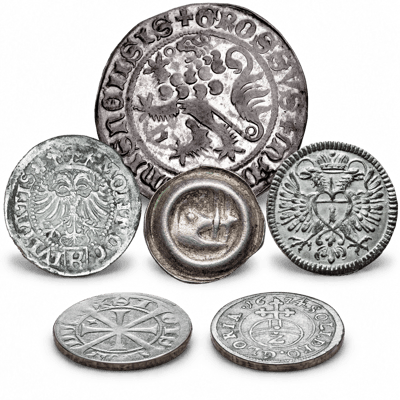
- Genuine Originals: no restrikes
- Four Centuries: six coin rulers
- As a Gift: history you can touch
- Genuine OriginalsThese silver coins were used as payment in the Old Empire
- Four CenturiesFrom the hollow penny of Silesia to the kreuzer of Regensburg
- As a GiftSix coins tell more than any greeting card







- Genuine Originals: no restrikes
- Four Centuries: six coin rulers
- As a Gift: history you can touch
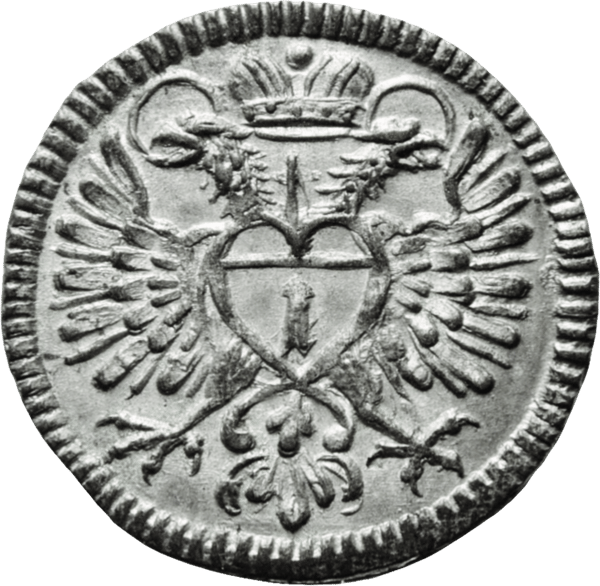 1 ×Silver 1 Kreuzer Free Imperial City of Regensburg (1623-1753 | Payment Money of the Cathedral City)
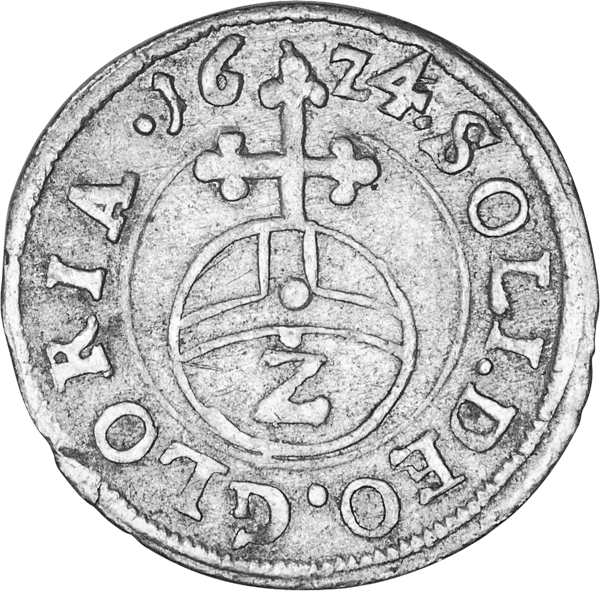 1 ×2 Kreuzer Silver Electorate of Bavaria (1623-1636 | Currency in the Thirty Years' War)
 1 ×1/2 Batzen Silver Free Imperial City of Kempten (1511-1533 | Era of the Peasants' Wars and Reformation)
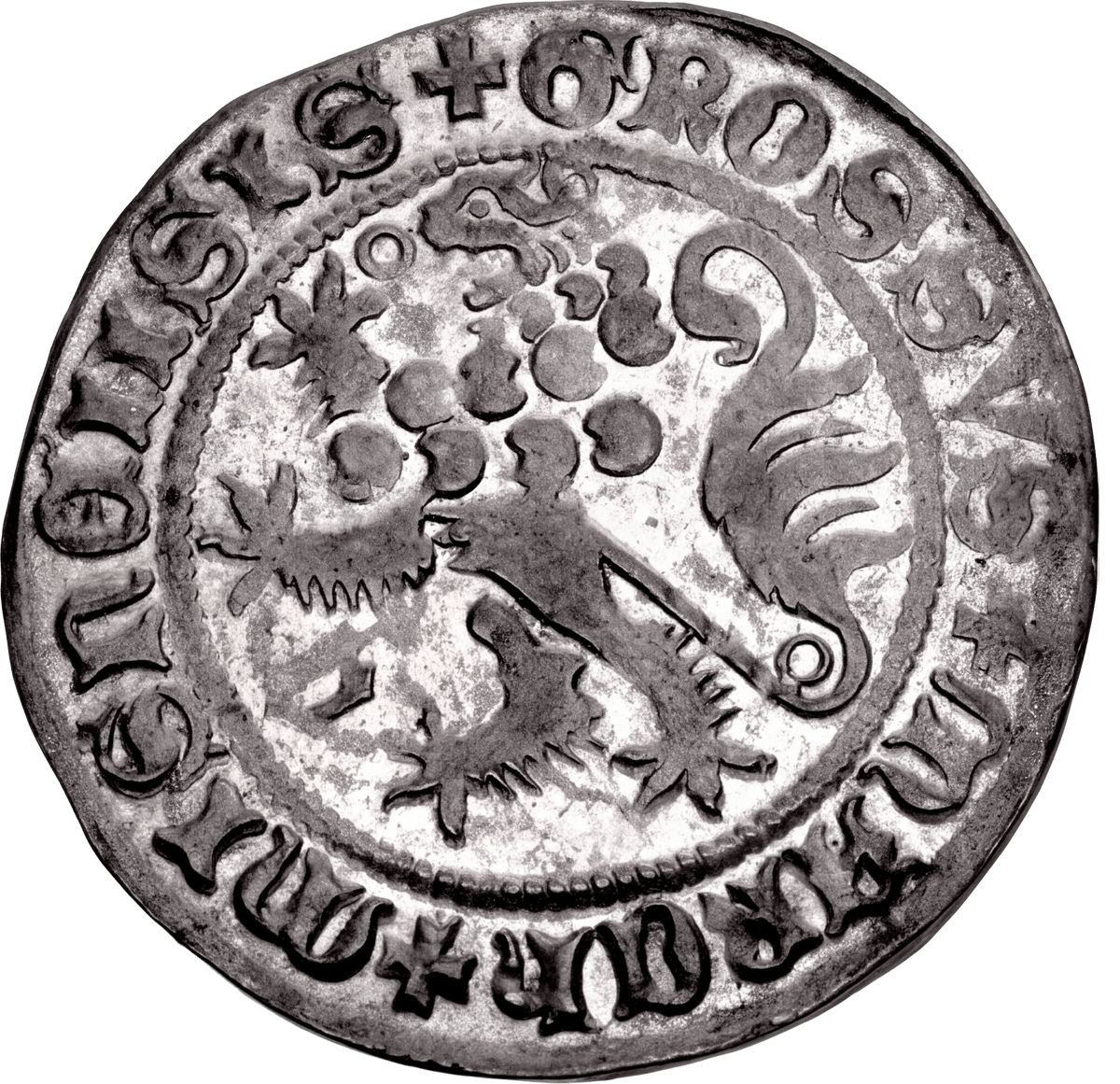
 1 ×Silver Fürstengroschen Balthasar of Thuringia (1381-1407 | Knight in the Hundred Years' War)
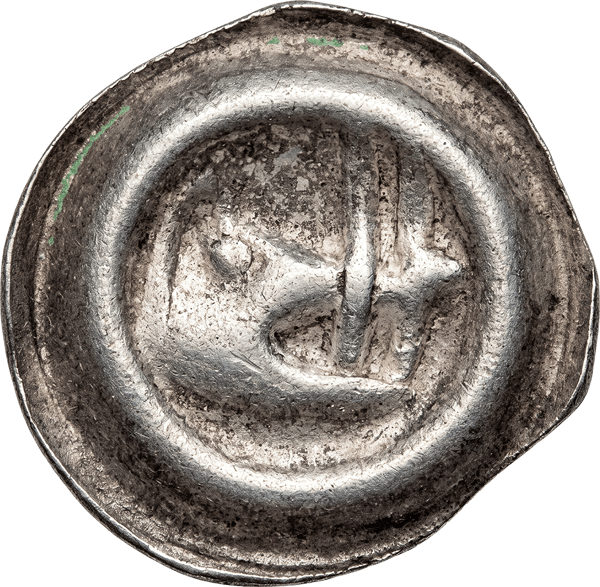 1 ×Silver Hollow Penny Boar with Tusks (14th-15th Century | Silesian Trade Coin of the Middle Ages)
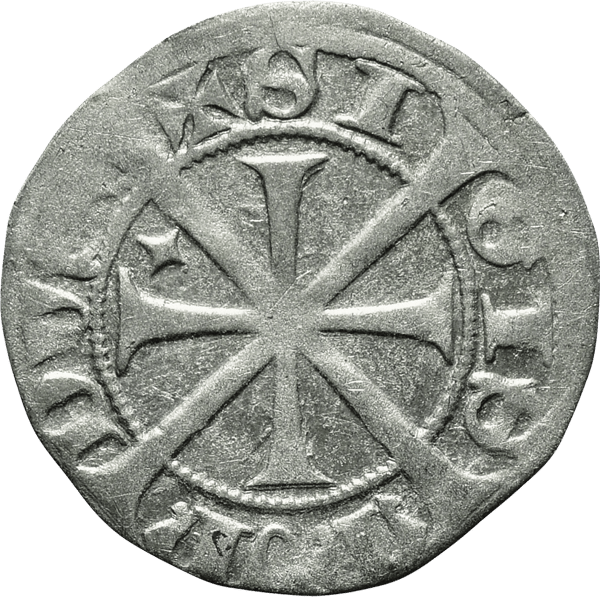 1 ×Silver Kreuzer Duchy of Tyrol (from approx. 1477 | Duke Siegmund of the House of Habsburg)
This package saves you £20.02
 Price alert
 Share

Holy Roman Empire
6 coins, one empire.From the boar to the keys of Regensburg.
Everyday money from 5 centuries, all 6 in silver: the bracteate from Schweidnitz, the prince’s groschen of Balthasar of Thuringia, the kreuzer from Tyrol, ½ batzen from Kempten, 2 kreuzer from Bavaria and 1 kreuzer from Regensburg.
- Coins
- 6
- Centuries
- 5
- Silver in total
- 7.5 g
Everyday money from 5 centuries, all 6 in silver: the bracteate from Schweidnitz, the prince’s groschen of Balthasar of Thuringia, the kreuzer from Tyrol, ½ batzen from Kempten, 2 kreuzer from Bavaria and 1 kreuzer from Regensburg.
- Coins
- 6
- Centuries
- 5
- Silver in total
- 7.5 g
Sizes compared
From 13.5 to 27 mm, all to the same scale.
The prince’s groschen measures 27 mm and weighs 2.85 g, the bracteate 13.5 mm at 0.2 g. All 6 together weigh 7.5 g. In southern Germany 4 kreuzer made a batzen and 60 kreuzer a gulden.
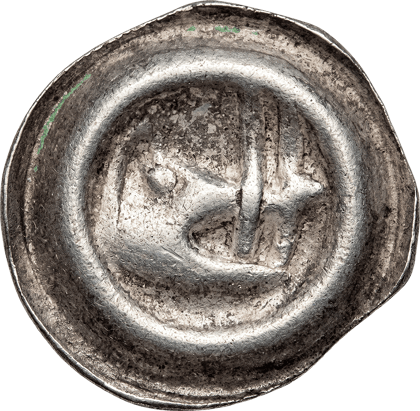
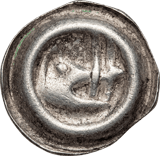 BracteateA thin sheet of silver, 13.5 mm and 0.2 g, struck from one side only: the boar with tusks, the sign of Schweidnitz.
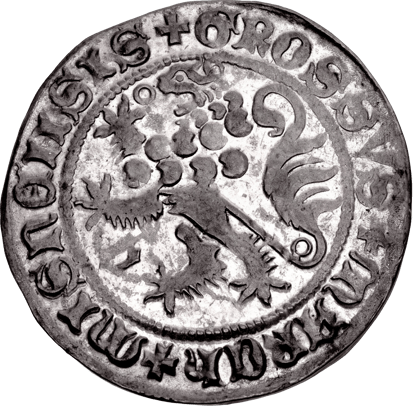
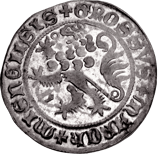 Prince’s groschenThe groschen of Balthasar of Thuringia, struck 1393 to 1406. 27 mm and 2.85 g of silver.
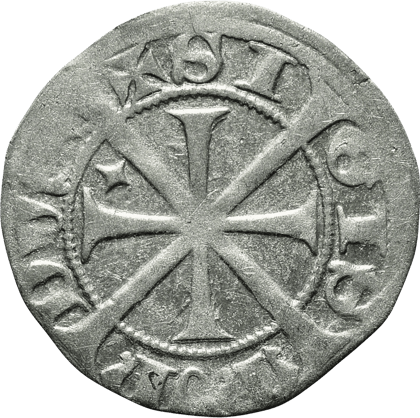
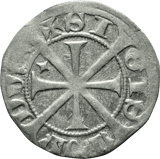 Kreuzer, TyrolThe kreuzer from Tyrol under Duke Sigismund of the House of Habsburg, struck from 1477. 18 mm and 0.7 g.
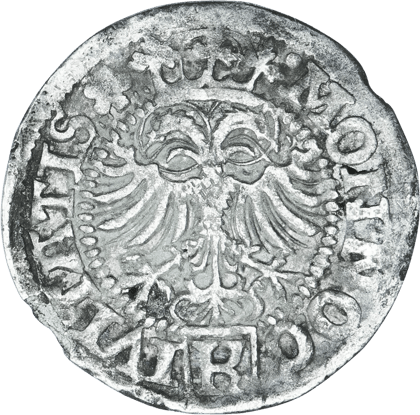
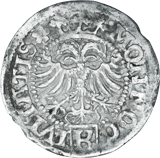 ½ batzen, Kempten½ batzen of the Imperial City of Kempten, 1511 to 1533, with the double-headed eagle. 21.5 mm and 2 g.
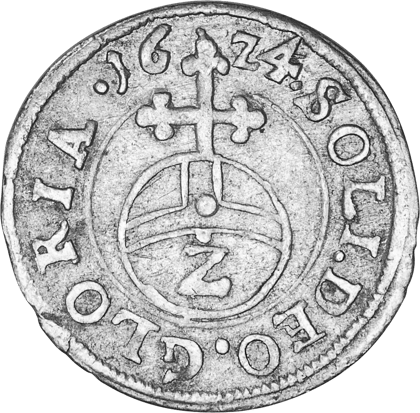
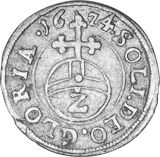 2 kreuzer, Bavaria2 kreuzer of Maximilian I of Bavaria, 1623 to 1636: the lozenge shield, the orb with the value 2 and SOLI DEO GLORIA.
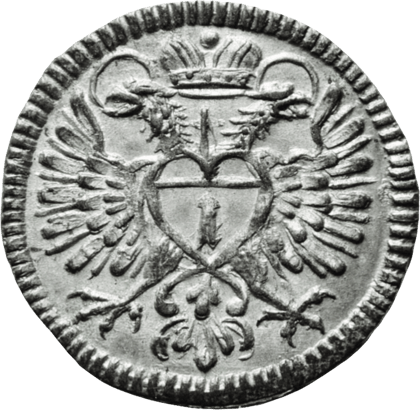
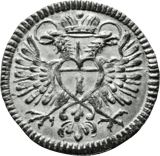 1 kreuzer, Regensburg1 kreuzer of the Imperial City of Regensburg, 1623 to 1753, with the crossed keys and the double-headed eagle bearing the 1. 16 to 17 mm.
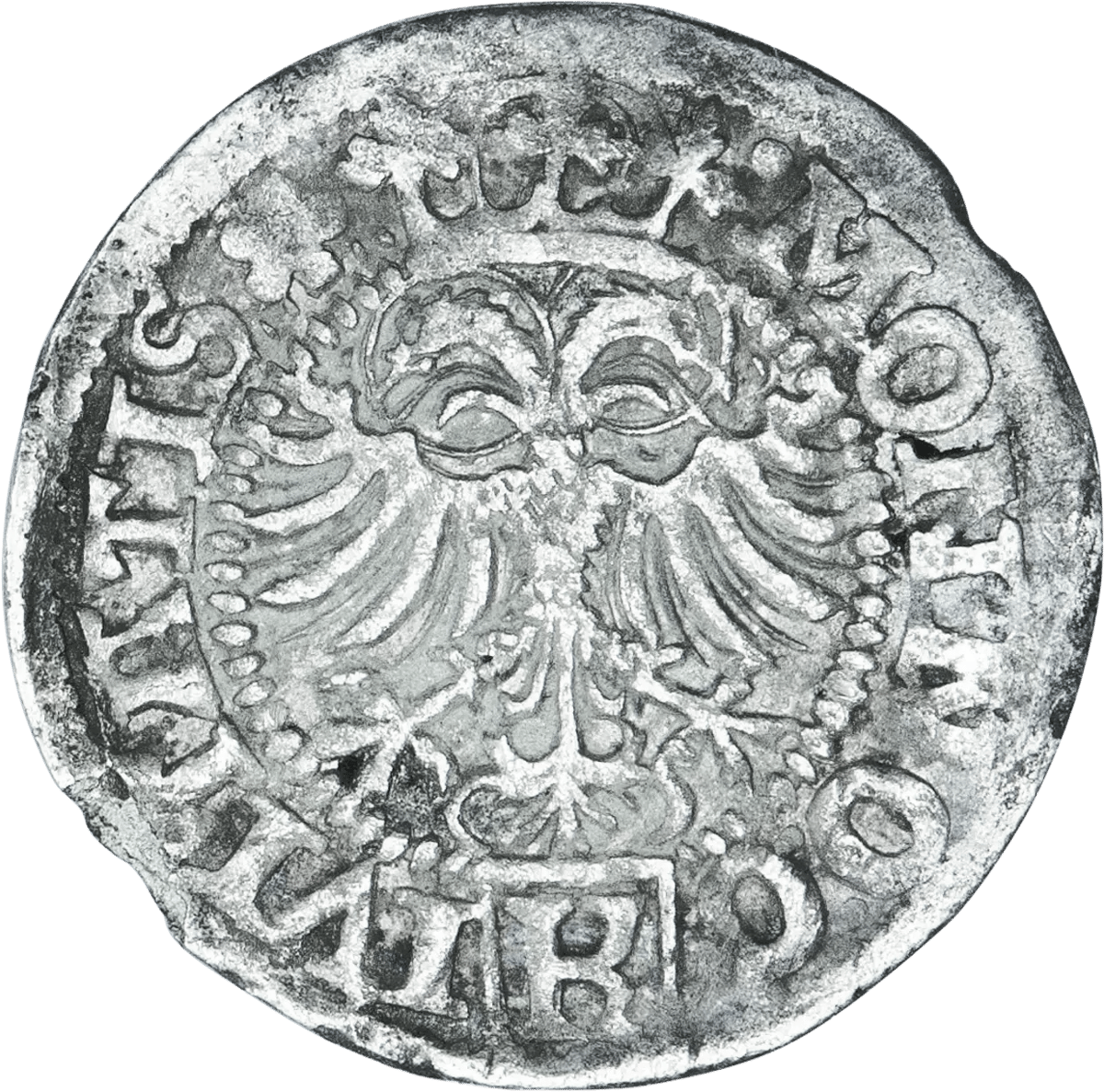
Imperial City of Kempten
½ batzen from Kempten, struck in the years of the Peasants’ War.
The Imperial City of Kempten struck its half batzen from 1511 to 1533, in the time of the Reformation and the Peasants’ War. It shows the double-headed eagle and the shield with the K of Campidona, the Latin name of the city. Half a batzen was worth 2 kreuzer.
From the 14th to the 18th century
From the bracteate to the kreuzer of the city of the Imperial Diet.
- c. 1300 to 1500
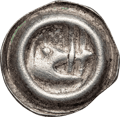 Bracteate
- 1393 to 1406
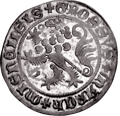 Prince’s groschen
- 1477 to 1490
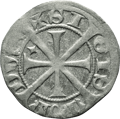 Kreuzer, Tyrol
- 1511 to 1533
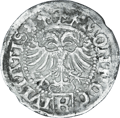 ½ batzen, Kempten
- 1623 to 1636
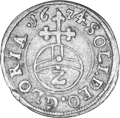 2 kreuzer, Bavaria
- 1623 to 1753
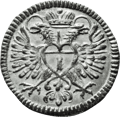 1 kreuzer, Regensburg
A boar, an eagle, 2 keys.6 coins from the Holy Roman Empire.
Regensburg bore the crossed keys, and from 1663 to 1806 the Perpetual Imperial Diet sat there. On the oak board in the vault all 6 stand together.
Six originals, four centuries: currency from the Holy Roman Empire of the German Nation
The Holy Roman Empire of the German Nation was not a state with a single currency. It consisted of numerous principalities, duchies, bishoprics and free cities – and almost anyone of standing minted their own coinage. This collection brings six of these minting authorities into your home. No medals, no restrikes: you receive six genuine historical silver coins that people actually used to make payments between the 14th and 18th centuries.
From the medieval hollow penny, barely heavier than a sheet of paper, to the broad prince's groschen of a knight from the Hundred Years' War. From the silver mines of Tyrol, through the rebellious Allgäu region, to the Danube, where the Perpetual Imperial Diet convened. Six pieces, six regions, one empire.
The contents of the collection – told chronologically
- Silver Prince's Groschen Balthasar of Thuringia (approx. 2.85 g): Landgrave Balthasar of the House of Wettin fought alongside the English King Edward III in the Hundred Years' War and was knighted in 1369. From 1393 onward, he had his prince's groschen minted in Freiberg and in the purpose-built Sangerhausen. The coin design shows the rearing Meissen lion on one side and the lily cross in a quatrefoil on the other. Minting ended with his death at Wartburg Castle in 1406.
- Silver hollow penny "Boar with Tusks" (approx. 0.2 g): Trade currency from medieval Silesia, 14th to 15th century. It was struck on only one side of an extremely thin silver sheet – the design therefore appears in hollow relief on the reverse. The boar's head refers to the trading town of Schweidnitz.
- Silver Kreuzer Duchy of Tyrol (approx. 0.7 g): Duke Sigismund of the House of Habsburg, known as "the Rich in Coin", moved the Tyrolean mint from Merano to Hall in the Inn Valley in 1477 – close to the productive silver mines of Schwaz. The double cross, from which the Kreuzer derives its name, defines the design of this denomination.
- 1/2 Batzen silver Imperial City of Kempten (approx. 2 g): Minted between 1511 and 1533, right in the midst of the Peasants' War and the Reformation. The crowned double-headed eagle bearing the shield letter "K" stands for Campidona, i.e. Kempten. In 1525, the citizens bought out their prince-abbot's remaining rights in the city in the "Great Purchase" – Kempten was free.
- 2 Kreuzer silver Electorate of Bavaria (approx. 1 g): Currency from the Thirty Years' War, minted from 1623. In that year, Maximilian I received the electoral title. The coin features the Wittelsbach diamond shield, the imperial orb with its denomination, and the motto SOLI DEO GLORIA – "To God alone the glory".
- Silver 1 Kreuzer Free Imperial City of Regensburg (approx. 0.75 g): The crossed keys of Saint Peter represent the cathedral city, accompanied by the imperial double-headed eagle bearing the denomination 1 on its chest. This Kreuzer was minted from 1623 to 1753, in the city where the Perpetual Imperial Diet convened from 1663 to 1806.
Together, the six coins weigh around 7.5 g in gross weight. Doesn't sound like much? In terms of history, it's a great deal.
Groschen, Batzen, Kreuzer, Pfennig: the small change of the Old Empire
Anyone holding this collection quickly understands why travellers in the Middle Ages and early modern period constantly needed money changers. The groschen in this collection originates from the Meissen-Thuringian region, the Batzen from the south, and the Kreuzer has its roots in Tyrol. In southern Germany, four Kreuzer equalled one Batzen, and sixty Kreuzer equalled one guilder. And the penny? It circulated as a small denomination almost everywhere, sometimes struck on both sides, sometimes as a one-sided hollow penny.
It is precisely this diversity that makes the collection so instructive. It shows not only coats of arms and rulers, but an entire monetary system that functioned for centuries. There was no central bank – payment was made with the silver itself.
On condition: circulated currency with a biography
As already explained for the individual items: these pieces are circulated currency – and they look it. Darker patina, individual centring, small nicks, wear, and in places weaker legend details: these are not flaws, but biography. Every trace stems from hands that, centuries ago, used these coins to settle goods, freight or debts.
Since the minting year, mint, and reverse variant can differ, the piece delivered may differ from the image shown. Please understand the photo in the shop explicitly as a sample image: appearance, exact weight and condition vary from piece to piece for historical reasons. The fineness, too, follows no modern standard but rather the minting standard of its time. You are acquiring an original – not a restrike, not a copy.
Gold is humanity's oldest currency and has outlived all others. Silver has always stood by its side as the money of everyday life. The empire that produced these six coins has been history since 1806 – its silver still lies in your hand today.
Why historical silver appeals to collectors and investors alike
For centuries, silver was the monetary metal of ordinary people, while gold secured the great fortunes. Both precious metals have outlasted currency reforms, wars and the collapse of entire empires. A collection like this therefore combines two motives that rarely coincide so clearly: the joy of history and the desire for a tangible asset.
- Preservation of value across generations: silver does not spoil, it develops a patina – and can be passed down within the family.
- Inflation hedge: as a scarce, physical tangible asset, silver has traditionally served to protect purchasing power.
- Scarcity: small denominations were worn down, lost, or ended up in the melting pot. Anyone wanting to assemble all six types individually today needs patience.
- Tax framework: profits from the sale of physical precious metals in Germany are generally tax-free, provided the minimum holding period of one year is observed.
Collection or individual piece? An honest comparison
All six coins are also available individually from us. The collection saves you the search and combines the pieces into a narrative spanning from the late Middle Ages to the Baroque era. Naturally, it cannot compete with modern bullion coins like the Vienna Philharmonic or the Maple Leaf in terms of fine silver content. Those seeking pure metal weight should opt for the ounce. Those wanting to hold history in their hands should choose this. Both complement each other perfectly.
For newcomers to numismatics, the collection is an ideal entry point; for experienced collectors, it is a fitting addition to Old German and medieval holdings. And as a gift? Six coins once held by knights, farmers, electors and merchants tell more than any greeting card. Shipping is carried out as insured value shipping.
Product image may differ from the actual product.
