





Wire Kopeck Tsar Peter the Great (1672-1725 | Currency of the Tsarist Empire)
- Over 300 years old: minted until 1718
- Hand-struck: every piece unique
- Blister card: with tsarist history
- Over 300 years oldIt marks the end of the nearly 200-year-old wire money tradition
- Hand-struckShape, design and year differ on every single specimen
- Blister cardA replica die shows the full coin design







- Over 300 years old: minted until 1718
- Hand-struck: every piece unique
- Blister card: with tsarist history
 Price alert
 Share

Peter the Great · struck until 1718
A tsar on horseback in silver:the wire kopeck of Peter the Great.
Peter was crowned tsar in 1682 at the age of 10. Under him the last wire kopecks were made, and in 1718 their striking ended.
- Metal
- Silver
- Gross weight
- about 0.4 g
- Coin type
- until 1718
Original from tsarist Russia, in a folding card. Image and shape vary from piece to piece.
Peter was crowned tsar in 1682 at the age of 10. Under him the last wire kopecks were made, and in 1718 their striking ended.
- Metal
- Silver
- Gross weight
- about 0.4 g
- Coin type
- until 1718
Original from tsarist Russia, in a folding card. Image and shape vary from piece to piece.

Under the lens
Tsar on horseback, double eagle, Peterhof: the card of the wire kopeck up close.
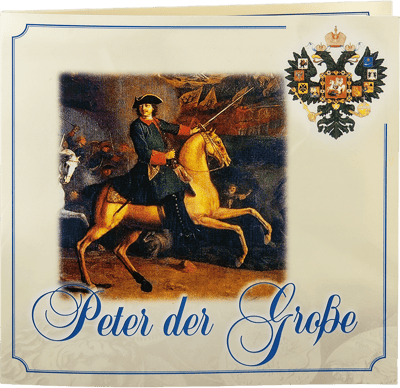
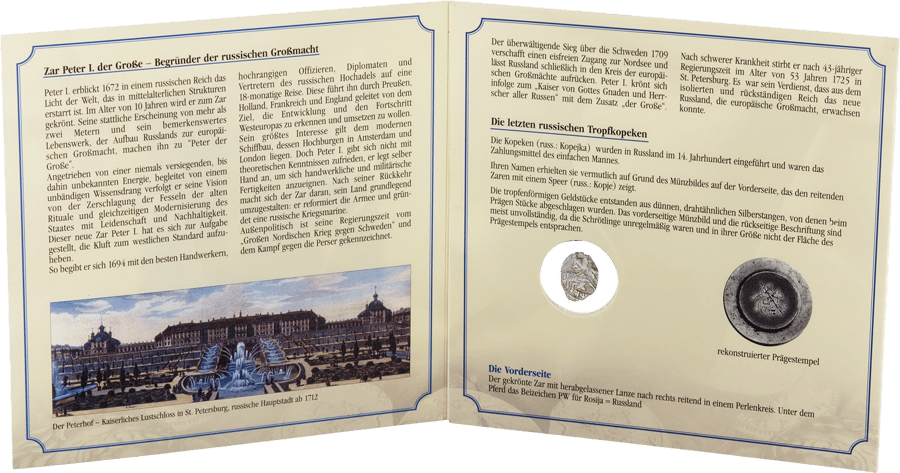
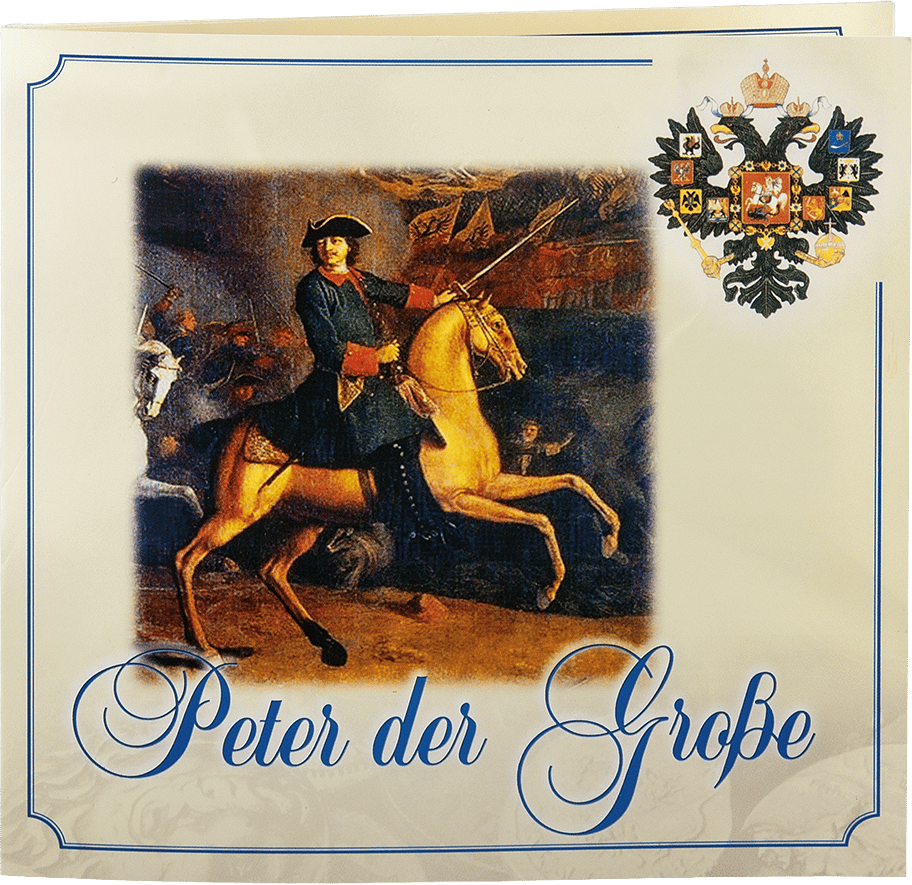
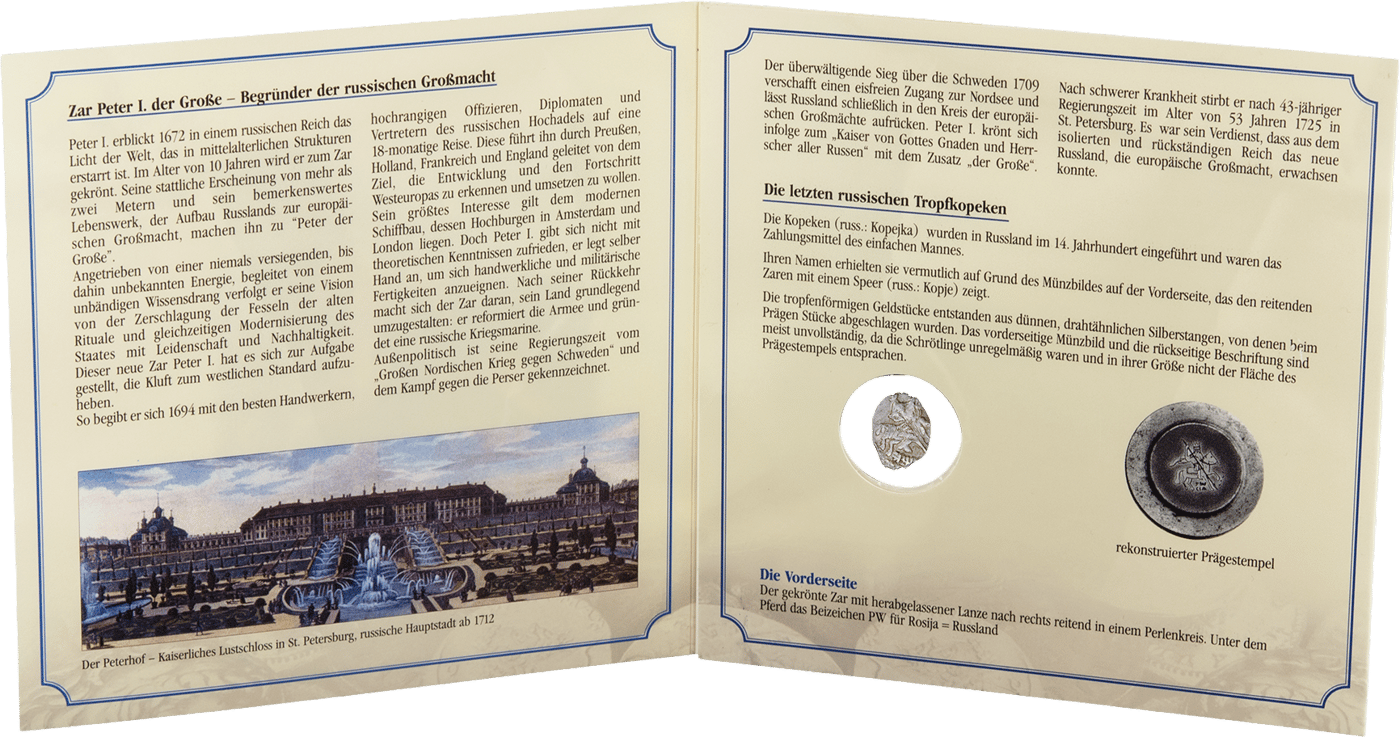
The wire kopeck lies in a folding card. Outside rides Peter, next to him the double eagle; inside are Peterhof, the window with the coin and a reconstructed die.
Money made of wire
Cut from silver wire, struck by hand: the wire kopeck.
Silver wire was cut into pieces and struck flat between 2 dies. That gave the pieces their drop shape, and that is why a kopeck mostly shows only part of its image. The kopeck probably takes its name from the rider’s spear, kopyo in Russian. The silver kopeck existed from 1535, and from 1704 Peter also had round kopecks struck in copper.
- gross weight of a silver kopeck
- about 0.4 g
- The silver kopeck is introduced
- 1535
- Peter has round kopecks struck in copper
- 1704

Preserved in silver for over 300 years:the wire kopeck of Peter the Great.
An original from tsarist Russia that brings its history with it. All details on your piece are at the top of the page.
Wire Kopeck of Tsar Peter the Great – genuine circulating currency from the Tsarist Empire
A piece full of history. This wire kopeck dates from the reign of Tsar Peter I, known as the Great, and was perfectly ordinary everyday currency in Russia around 1700. Craftsmen, farmers and merchants used it to pay for their daily purchases in the markets of Moscow. Today you hold an original piece of silver in your hand that takes you back to the era when Russia rose to become a European great power.
Each piece is a one-of-a-kind item. Shape, design, year of issue and condition all differ, since no two wire kopecks were ever struck alike. You receive the coin as a circulated piece in an illustrated blister card that tells the story of the coin and its ruler.
Why is it called a "wire kopeck"?
This is due to the way it was made. Silver was drawn into a thin wire, cut into small pieces, and these were then flattened between two dies. The result was oval, droplet-shaped flans. Hence the names "drop kopeck" and "wire kopeck". In Russia, these coins are called "cheshuya", meaning "scales", because of their scale-like appearance.
The flans were irregular and usually smaller than the die itself. As a result, almost every kopeck shows only a section of the full design. Herein lies its rough, authentic charm: looking at a wire kopeck, one can easily picture the minter at the anvil.
The design and key facts at a glance
- Obverse: The crowned Tsar rides to the right with a lowered lance, surrounded by a beaded border. This design gave the kopeck its name (Russian "kopjo" = spear).
- Reverse: multi-line Cyrillic inscription bearing the ruler's title, roughly translating to "Tsar and Grand Prince Pyotr Alekseyevich of All Russia", usually only partially visible
- Dating: Many pieces from Peter's reign also bear a year in Cyrillic numeral letters.
- Gross weight: approx. 0.4 g
- Material: silver
- Condition: circulated piece, year of issue and condition vary by specimen
- Packaging: blister card with historical information
Peter the Great – the Tsar who opened Russia to the West
Peter I was born in 1672 and crowned Tsar as early as 1682, at the age of ten. What followed is one of the most impressive life stories among European rulers. With his "Grand Embassy" he travelled through Prussia, Holland and England. He worked in shipyards himself and brought home knowledge, craftsmen and new ideas. He reformed the army and administration, founded the Russian navy, and made the newly established city of Saint Petersburg on the Baltic Sea the capital.
In the Great Northern War, he decisively defeated the Swedes at Poltava in 1709. In 1721 he adopted the title of Emperor. By the time he died in 1725, Russia had become one of the great powers of Europe.
With the wire kopeck, a nearly 200-year-old coinage tradition came to an end, and modern Russian currency began.
The last of their kind
The silver kopeck was introduced in 1535 through the coinage reform of Regent Elena Glinskaya. Alongside it existed the denga, worth half a kopeck. For almost two centuries, these coins were struck using the wire technique, with their weight gradually decreasing. Peter the Great brought this era to an end. His coinage reform introduced round, machine-struck coins modelled on Western examples: copper kopecks from 1704, the grivennik worth ten kopecks, and the silver ruble. The last wire kopecks were struck in 1718.
Peter the Great's wire kopecks are therefore among the very last Russian wire coins ever produced. They form a link, in silver, between old Muscovite Russia and the new Tsarist Empire.
In comparison: kopecks of other tsars
Collectors of Russian wire kopecks will quickly come across pieces from Ivan IV, the Terrible, or from Mikhail Fyodorovich (1613–1645), the first Tsar of the House of Romanov. These older kopecks are somewhat heavier and equally appealing. However, the coins struck under Peter the Great have a special distinction: they bear the name of arguably Russia's most famous ruler and mark the end of the wire-money era. Next to the later round copper kopecks, they appear more archaic and primitive. It is precisely this contrast that appeals to many collectors. Since each piece looks different, the protective blister card suits it perfectly. It keeps the kopeck safely stored while presenting it attractively.
For collectors, history enthusiasts and as a gift
Silver has served humanity as a store of value for thousands of years, and precious metal remains, to this day, the embodiment of permanence. This wire kopeck shows how silver circulated for centuries as perfectly ordinary money. As a collector's item, it holds great historical appeal and also offers an easily accessible entry point into Russian numismatics.
- Original silver coin from the era of Peter the Great, over 300 years old
- Every piece a hand-struck one-of-a-kind item
- Blister card featuring an equestrian portrait of the Tsar, the double-headed eagle coat of arms, and detailed accompanying text
- A wonderful gift for history enthusiasts, Russia connoisseurs and coin collectors
The blister card is itself a small showpiece. On the outside, it depicts Peter the Great on horseback and the coat of arms with the imperial double-headed eagle. Inside, it tells the story of his life, shows Peterhof Palace, and compares the original coin with a reconstructed die. This lets you see at a glance what the complete design originally looked like.
Bring home a genuine piece of Tsarist history, from Kettner Edelmetalle.
Product image may differ from the actual product.
