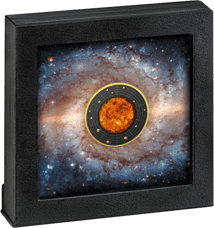
Offer -£4.17


Gold Milky Way Coin
£29.14£33.31
VAT-free and excl. shipping
Available in 2–3 business days

 More than 280,000
 Over 30 years
 Secure shipping
 Google: 4.9/5


On 20 July 1969 at 20:17:39 UTC, the lunar module of Apollo 11 touched down in the Sea of Tranquility. It stayed for 21 hours and 36 minutes. The timeline shows the whole journey, hour by hour.
Launch
16 July 1969, 13:32:00 UTCMission time 0 h
Apollo 11 lifts off. This starts the mission time, which the timeline shows in hours.
Landing
20 July 1969, 20:17:39 UTCMission time 102 h 45 min 40 s
The lunar module touches down in the Sea of Tranquility, about four miles, or just over 6 km, beyond the calculated point and almost a minute and a half earlier than planned.
First step
21 July 1969, 02:56:15 UTCMission time 109 h 24 min 15 s
Neil Armstrong steps onto the Moon, and Buzz Aldrin follows about 20 minutes later. By Houston time it is still 20 July.
Liftoff
21 July 1969, 17:54:00 UTCMission time 124 h 22 min 1 s
The lunar module lifts off from the Moon, 21 hours and 36 minutes after landing.
Splashdown
24 July 1969, 16:50:35 UTCMission time 195 h 18 min 35 s
The capsule splashes down. The whole mission lasted 8 days, 3 hours, 18 minutes and 35 seconds.
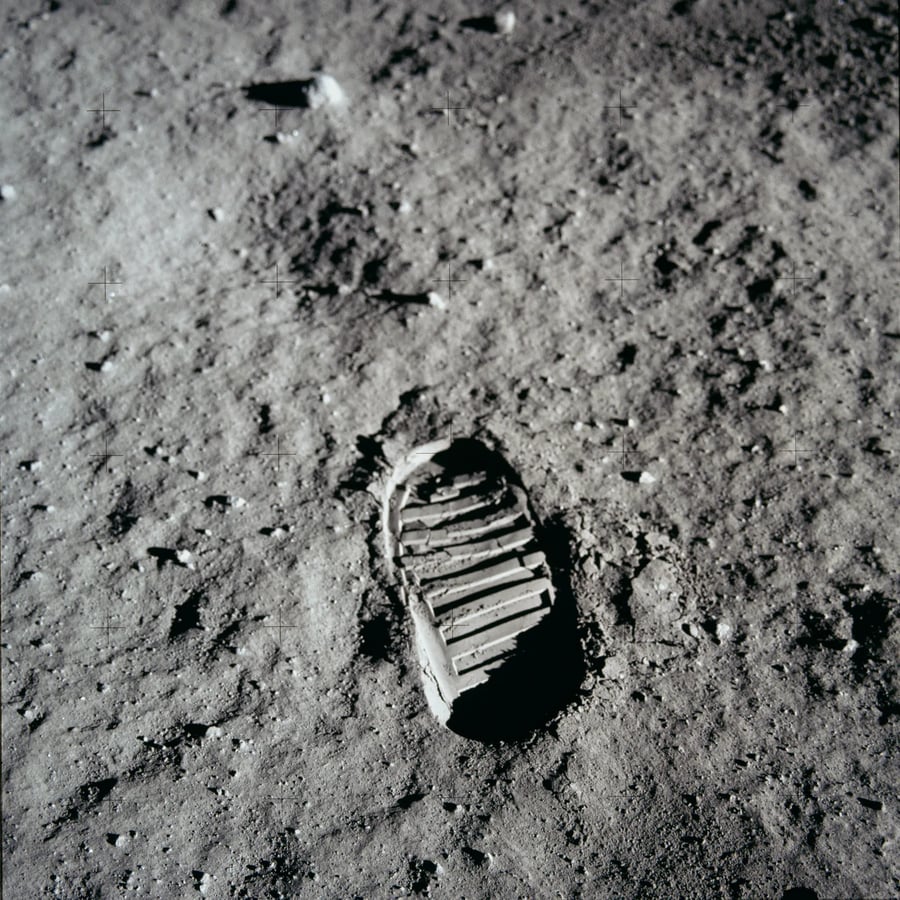
Many captions give 20 July for the first step, the date in American local time. In UTC it was already the 21st. An estimated 650 million people watched this step on television.
The two were outside for just over two and a half hours: the hatch opened on 21 July at 02:39:33 UTC and closed again at 05:11:13 UTC.
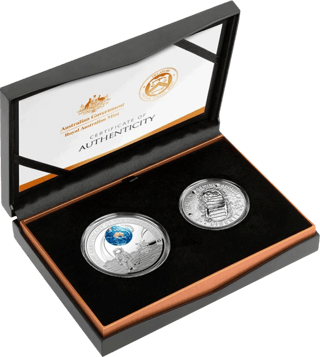
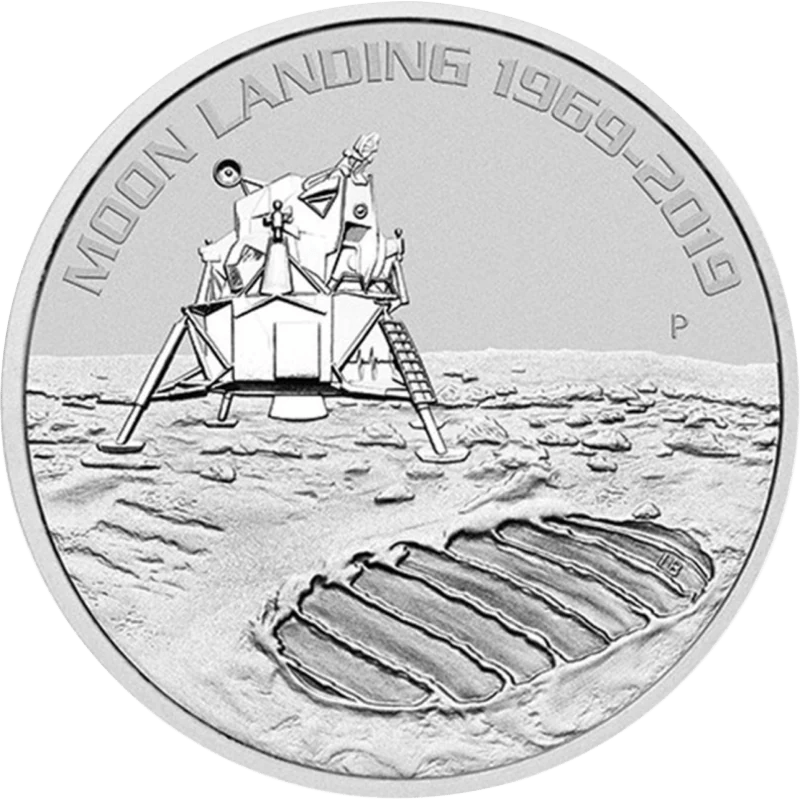
The Perth Mint’s coin for the 50th anniversary shows the lunar module behind a large boot print, with the inscription “MOON LANDING 1969‑2019”.
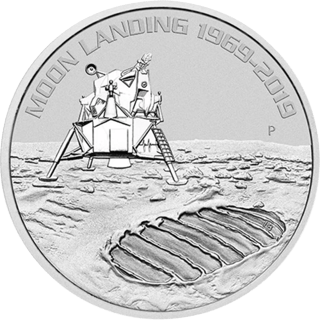 Boot print, silverBoot printMoon landing at 50, Perth MintSilver, Perth Mint
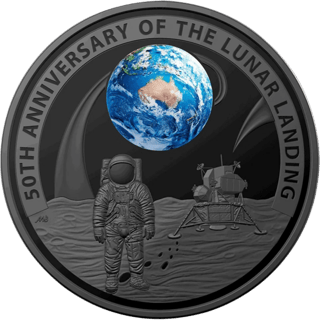 Earth with Australia, silverEarth with AustraliaMoon landing at 50, domedSilver, domed
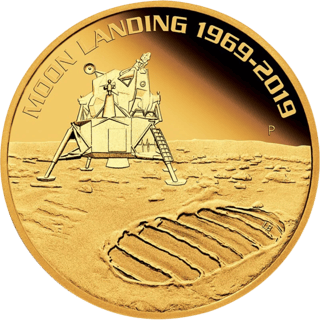 Boot print, goldBoot printMoon landing at 50, Perth MintGold, Perth Mint
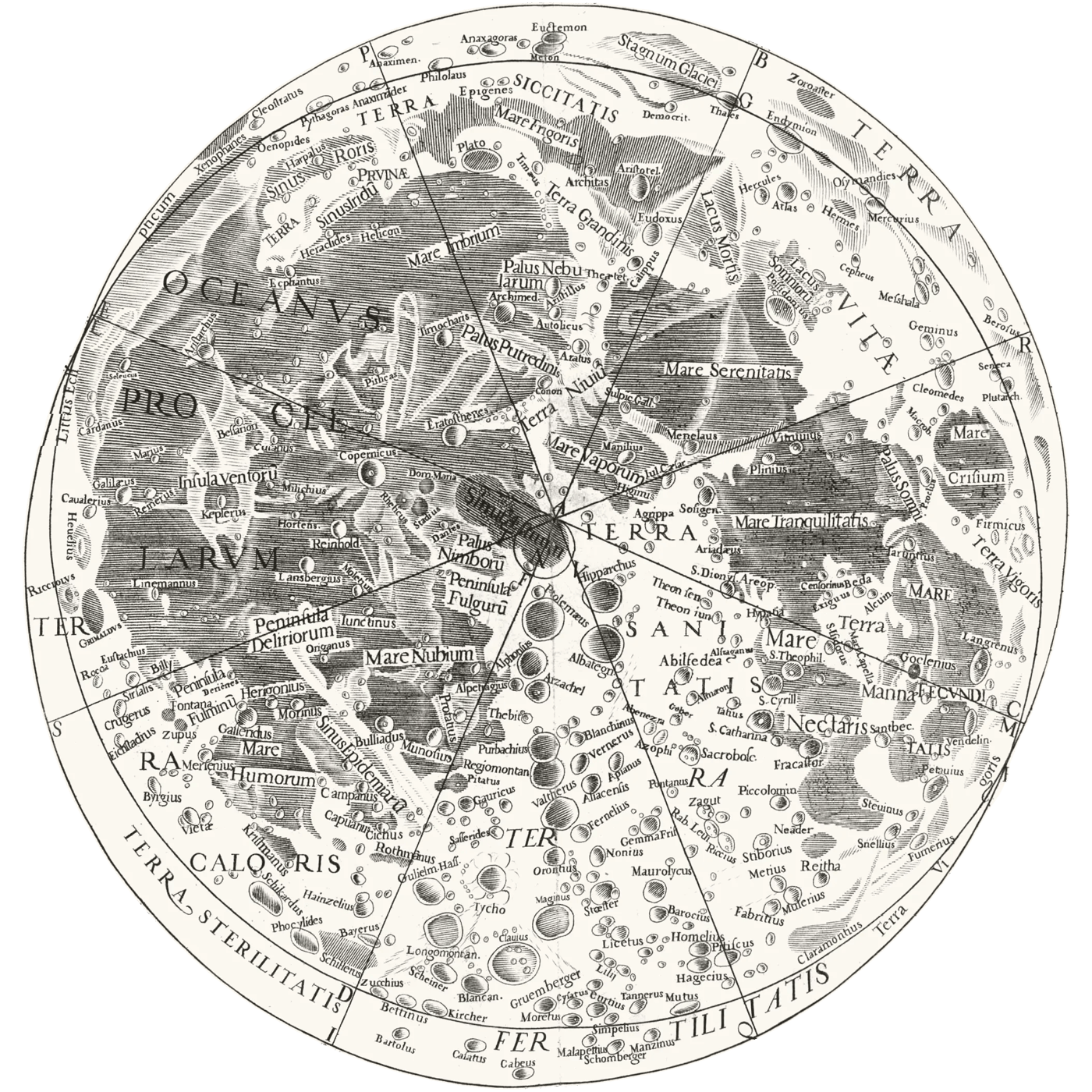
The lunar map in the “Almagestum novum”, Bologna 1651, laid the foundation for the system of lunar names that is still in use today.
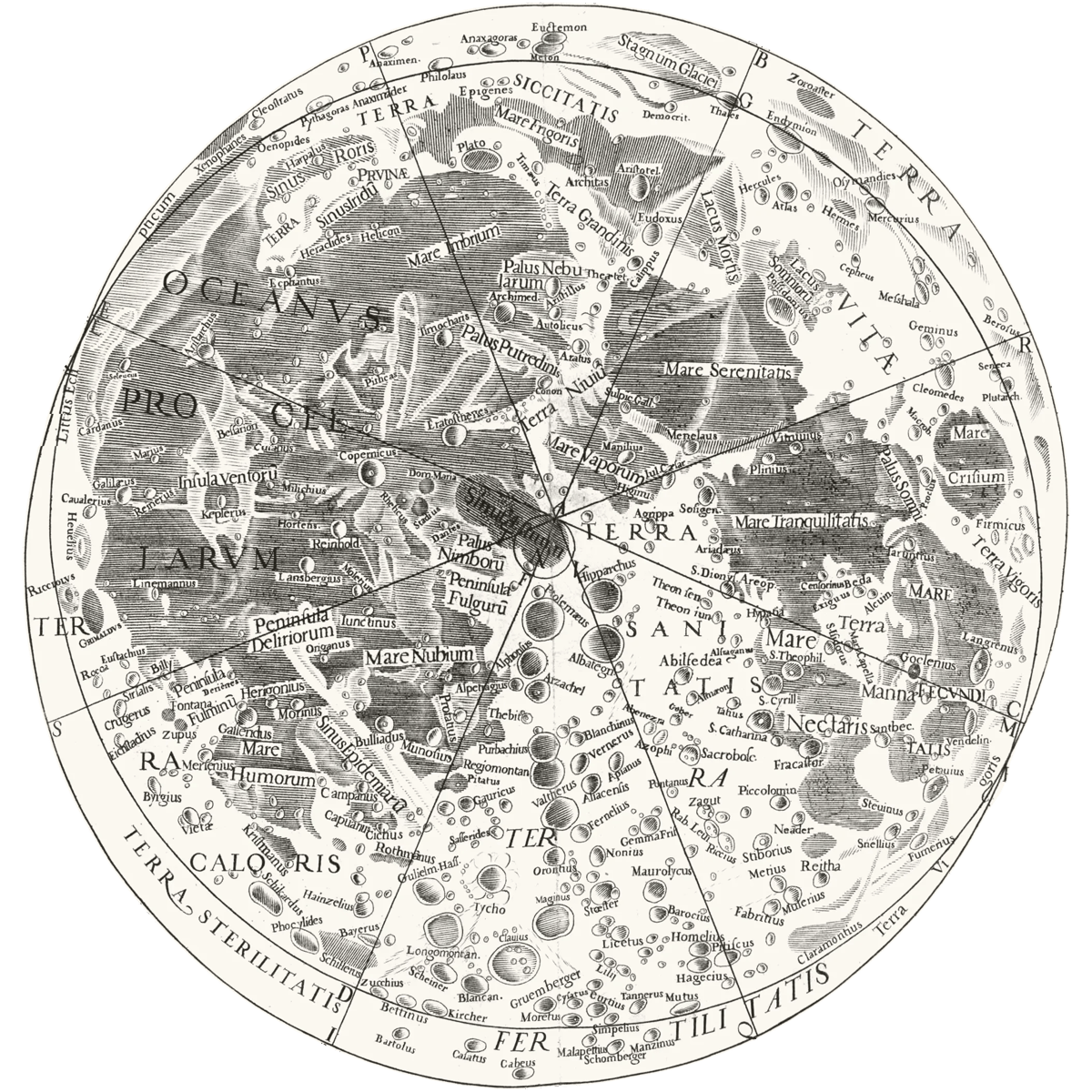
Grimaldi drew the map, Riccioli devised the names. This is where the Sea of Tranquility got its name, Mare Tranquillitatis, along with craters such as Plato, Ptolemaeus and Tycho.
From 1651 to the landing, 318 years passed. Apollo 11 touched down in this sea, at 0°41′15″ north and 23°26′ east.
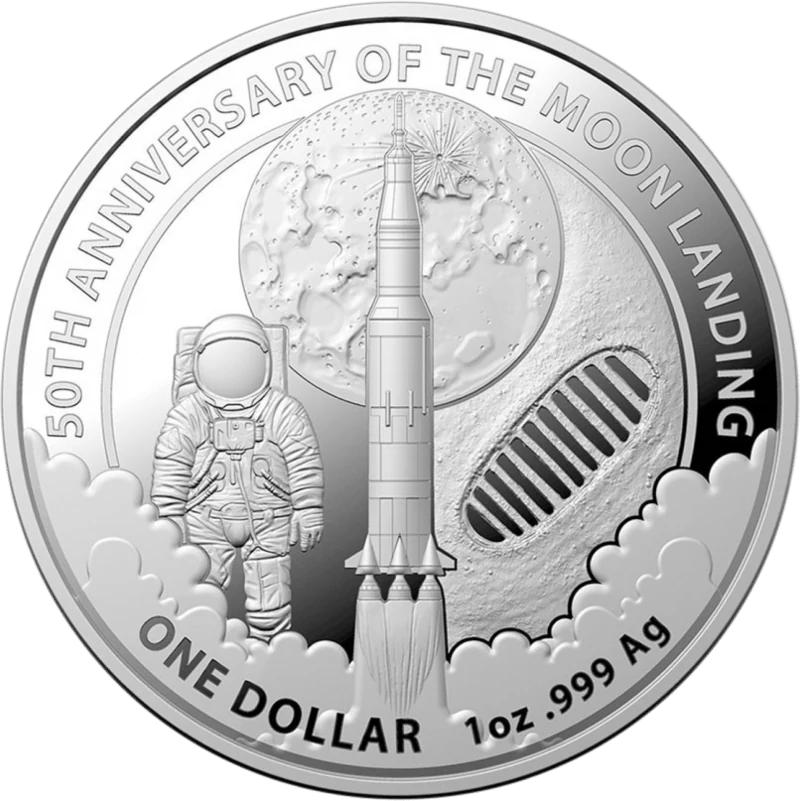
The coin for this chapter shows an astronaut and a rocket, with the Moon behind them in cratered relief.
Light travels almost 300,000 km every second. From the Sun to Earth it takes 8 minutes and 19 seconds on average, to Neptune 4 hours and 11 minutes.
Timeline from 0 to 6 hours. Sunlight reaches Mercury after 3 min 13 s, Venus after 6 min 1 s, Earth after 8 min 19 s, Mars after 12 min 41 s, Jupiter after 43 min 17 s, Saturn after 1 h 19 min 37 s, Uranus after 2 h 39 min 23 s and Neptune after 4 h 11 min. On 14 February 1990, Voyager 1 was about 5 h 36 min away in light travel time.
The first 15 minutesThe first 15 minutes
 Sun
 Mercury3 min 13 s
 Venus6 min 1 s
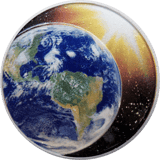 Earth8 min 19 s
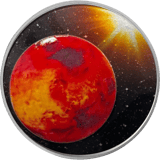 Mars12 min 41 s
The first 6 hours
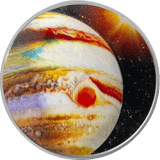 Jupiter43 min 17 s
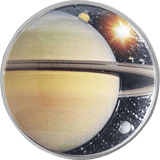 Saturn1 h 19 min 37 s
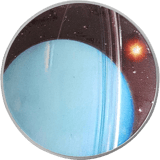 Uranus2 h 39 min 23 s
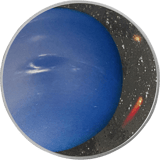 Neptune4 h 11 min
Voyager 1, 14 February 1990: about 5 h 36 min
Calculated for the planets’ mean distance from the Sun.
Because Earth’s orbit is not an exact circle, light takes between 8 min 11 s and 8 min 27 s over the course of the year.
Light from the Moon takes just under 1.3 seconds to reach Earth.
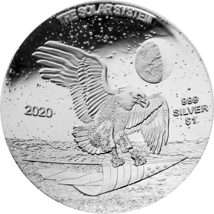
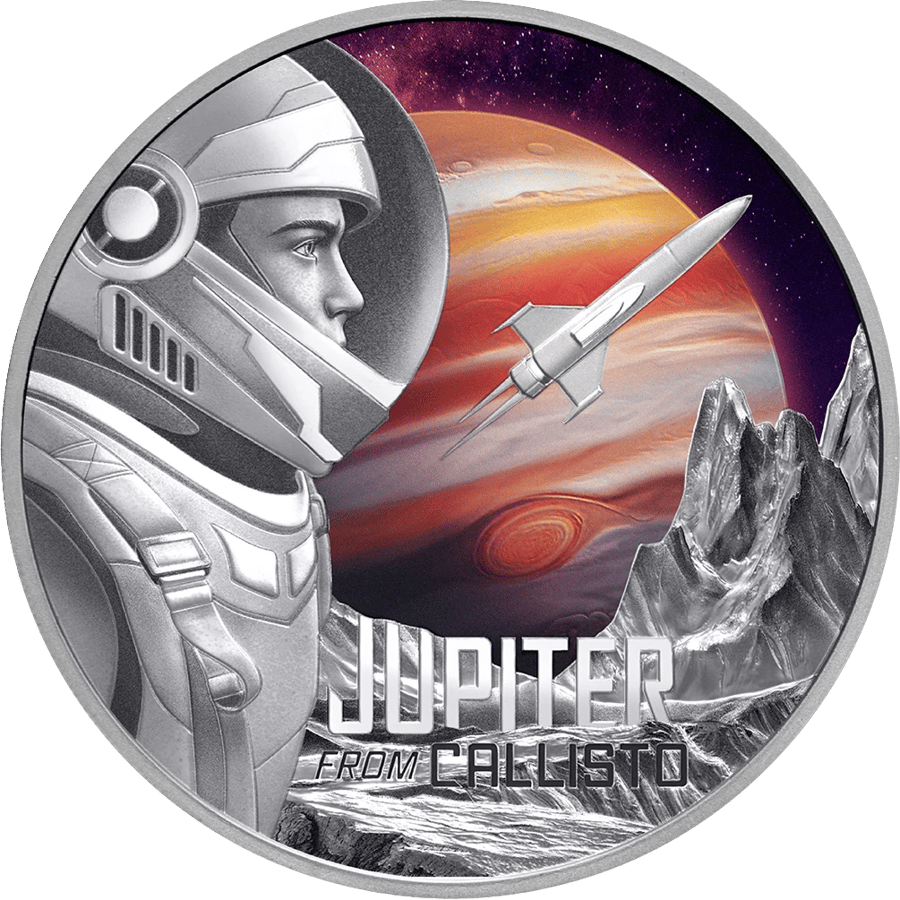
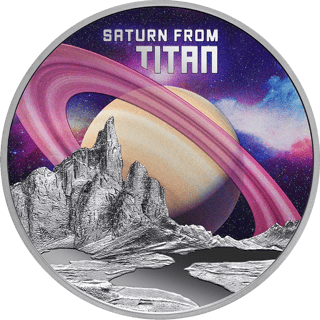
The rounds of the series “THE SOLAR SYSTEM” each show one body as a coloured disc against a dark background: the Sun in full, Jupiter with the Great Red Spot, Saturn with its ring.
How large would a planet appear in the sky of its moon? Calculated from the moons’ orbits and compared with the full Moon, which we see from Earth as 0.52 degrees wide.
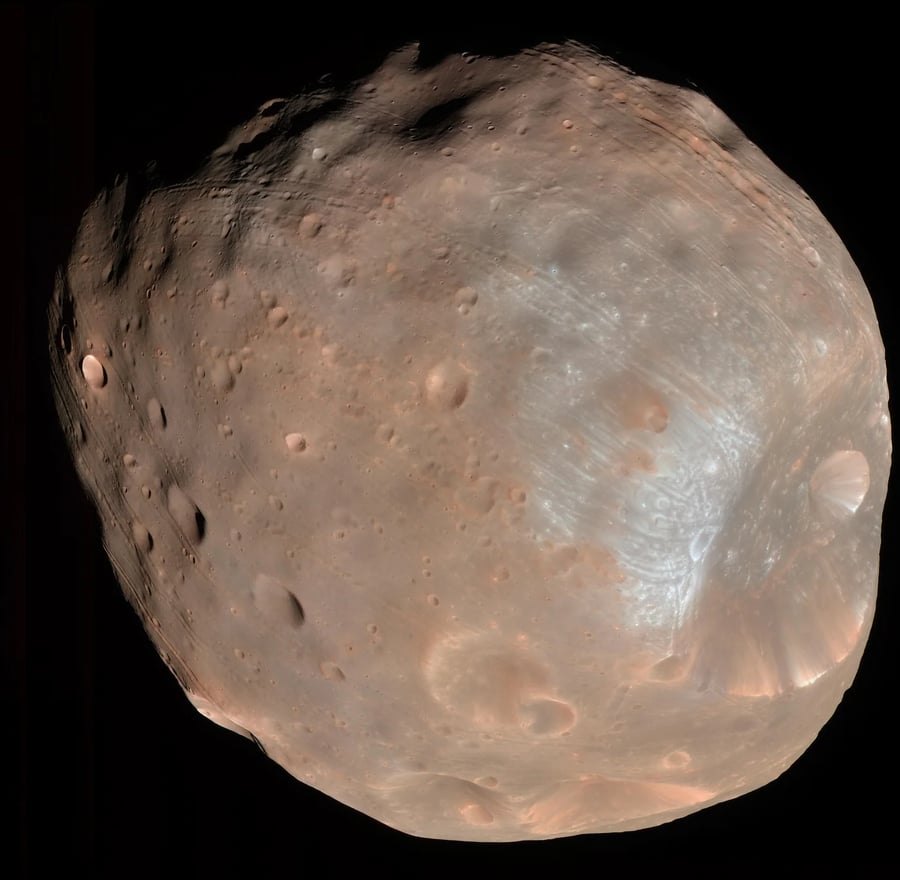
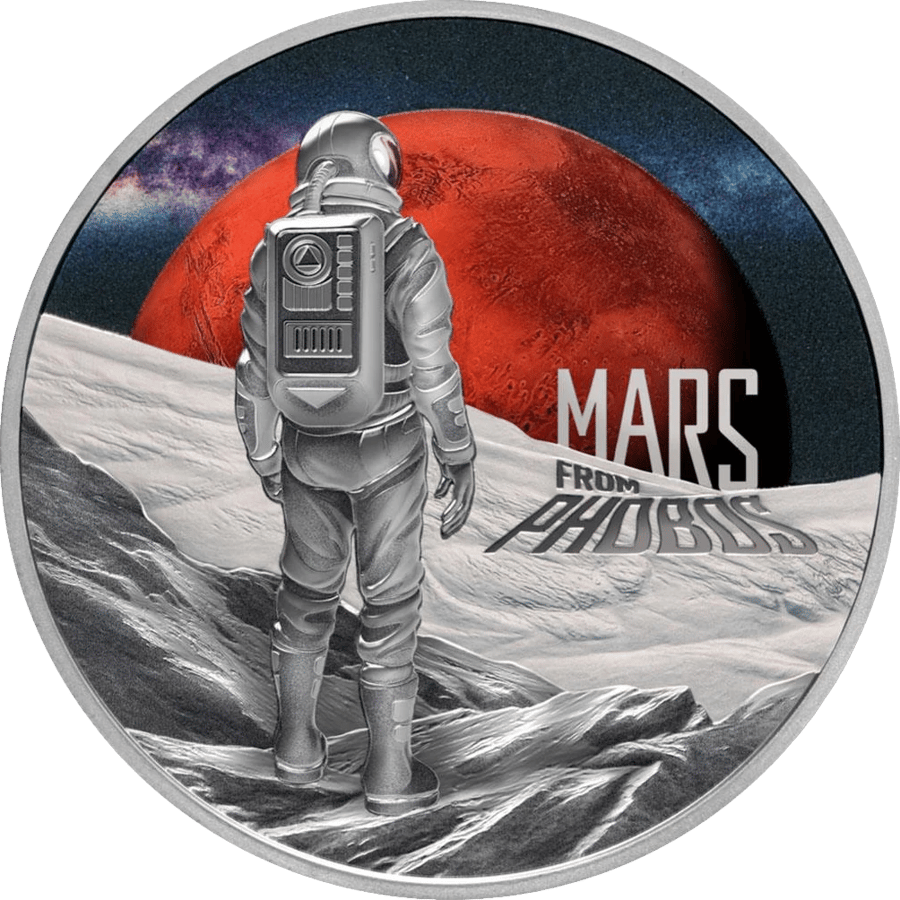
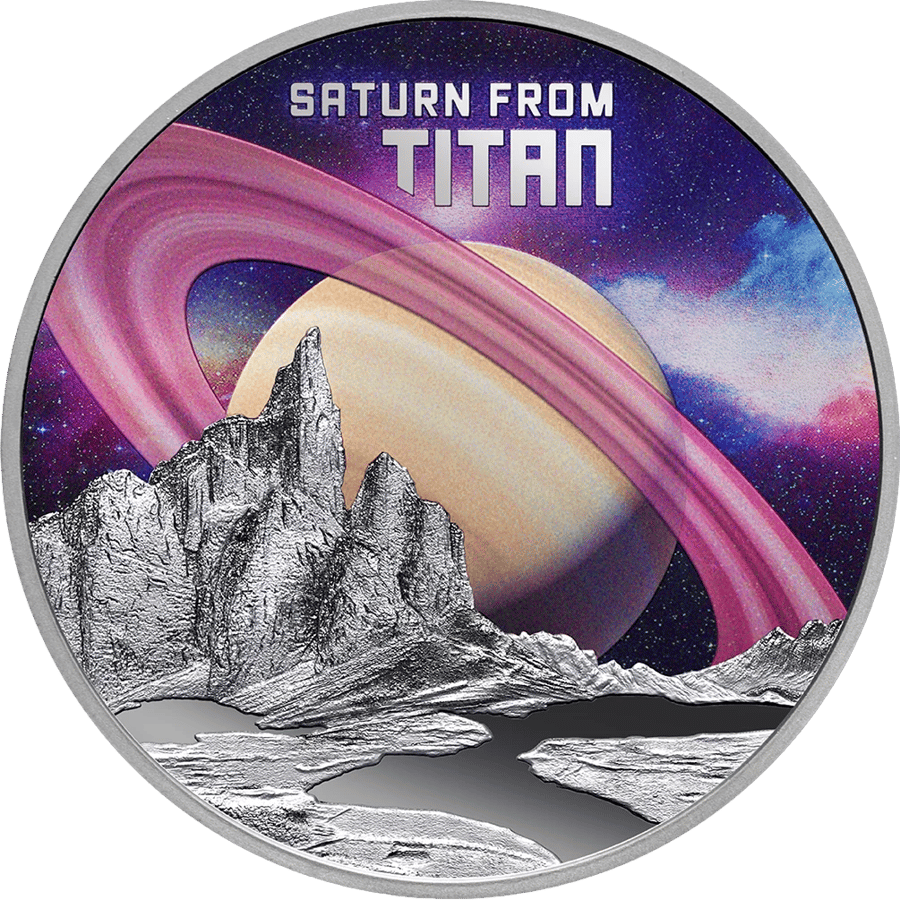
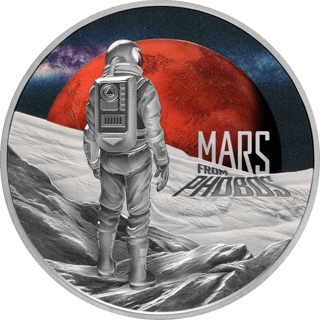
Seen from Phobos, Mars would fill a large part of the sky: 42.5 of the 180 degrees from horizon to horizon. Saturn and Jupiter would appear much smaller in the skies of their moons, yet still wider than eight full Moons side by side.
The coins in the series show the view itself.
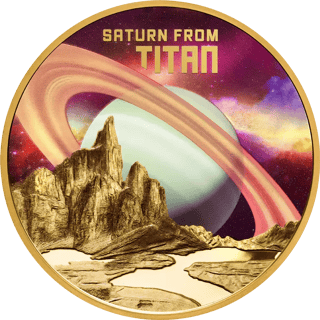 Saturn from Titan, goldSaturn from TitanRinged planet over pinnaclesGold, over pinnacles
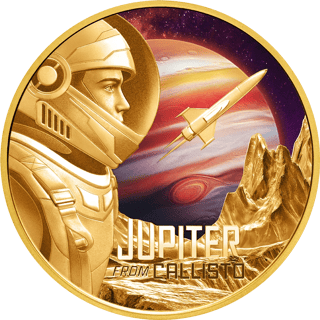 Jupiter from Callisto, goldJupiter from CallistoAstronaut and rocket against JupiterGold, against Jupiter
Three photos of Earth, each taken from farther away than the one before.
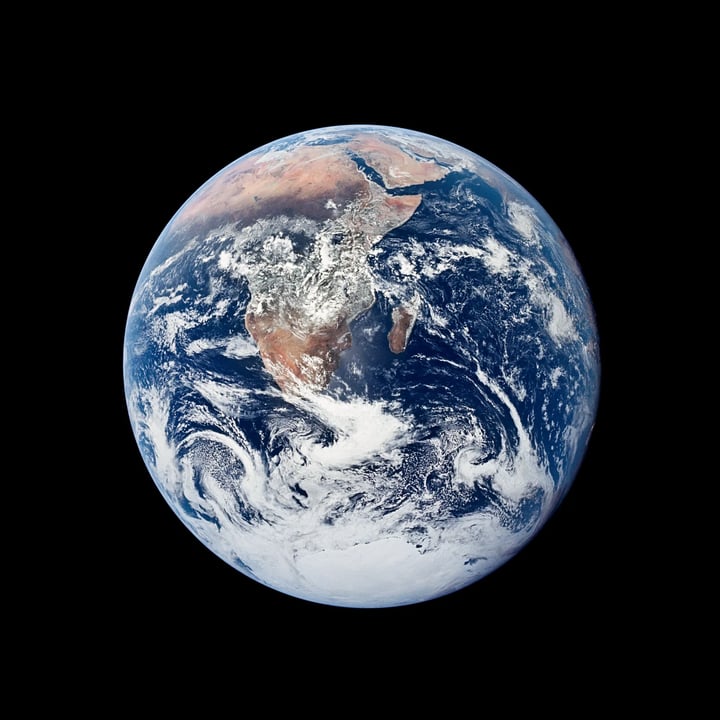
Distance: on the way to the Moon
Apollo 17, 7 December 1972
Earth fills about two thirds of the image width.
Almost cloud‑free Africa, Saudi Arabia at the top, Antarctica with the South Pole at the bottom. The last Apollo mission to the Moon.
Image: NASA
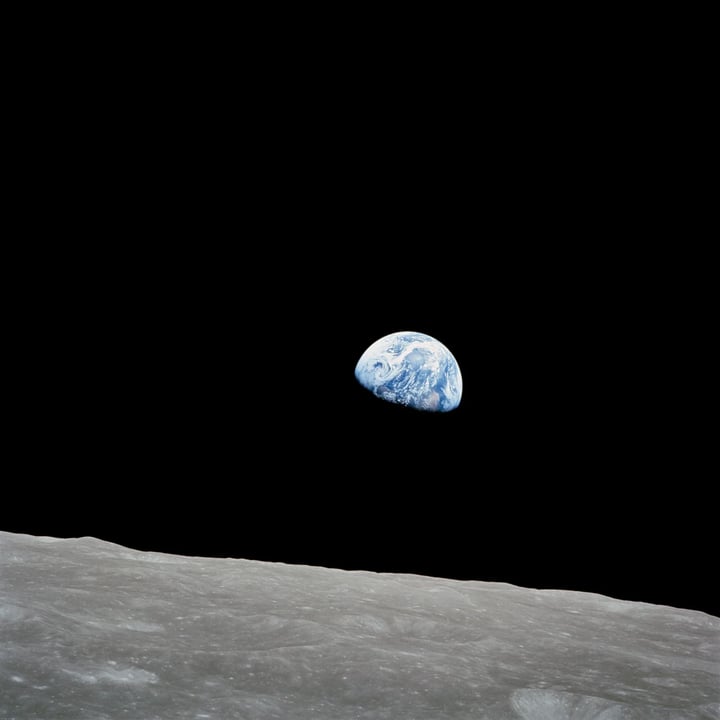
Distance: about 386,000 km
Apollo 8, 24 December 1968
Earth takes up about one seventh of the image width.
Earth stands about five degrees above the lunar horizon. The line between day and night runs across Africa.
Image: NASA
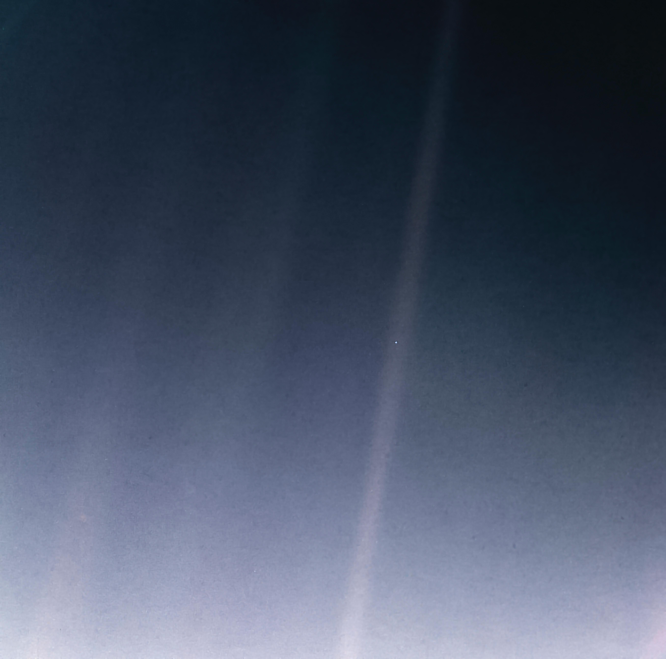
Distance: about 6 billion km
Voyager 1, 14 February 1990
Earth is smaller than a single pixel. The ring shows where it lies.
34 minutes later the probe switched off its cameras for good. The name “Pale Blue Dot” comes from a book by Carl Sagan, 1994.
Image: NASA/JPL‑Caltech
How large Earth appears in a picture does not show the distance on its own: Earthrise was taken with a telephoto lens.
The coins that go with them show their own pictures of Earth.
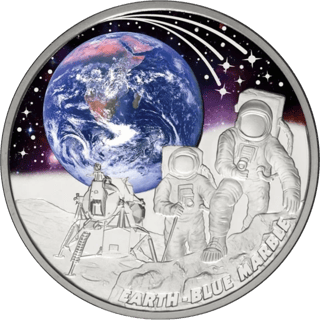 Blue Marble 2022, silverBlue Marble 2022Earth above the MoonEarth above the Moon
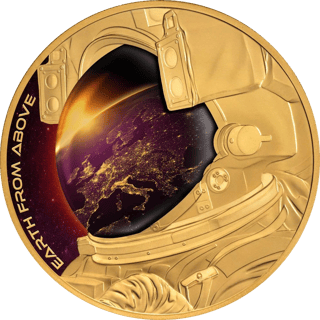 Earth From Above 2022, goldEarth From Above 2022Earth at night in the visorEarth in the visor
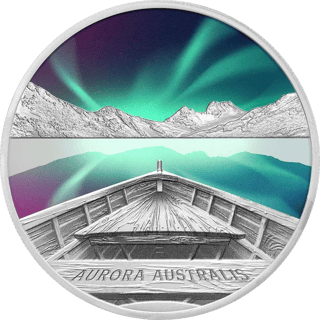
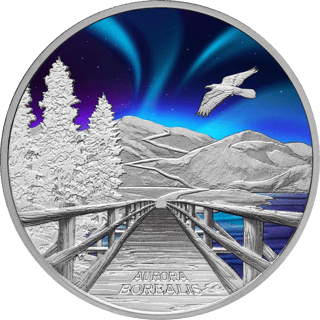
Aurora glows far above the clouds, from below 100 km to above 200 km in altitude. Its colour depends on the altitude and on the gas that glows.
Calculated without the Moon’s limb profile: the times may shift by about 1 to 3 seconds.
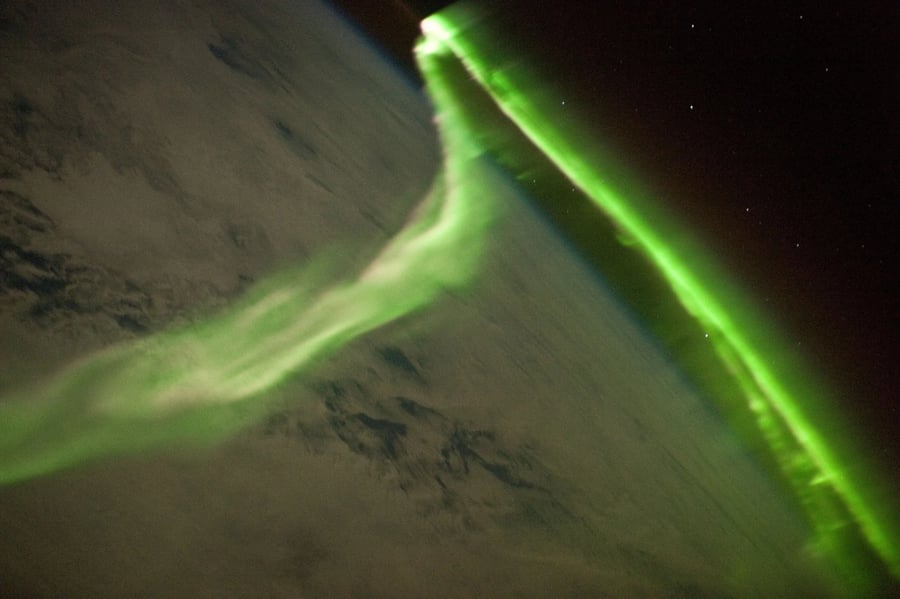
Auroras are not unique to Earth: they have also been seen on Saturn and Jupiter.
The date of this eclipse appears on the rim of the Ningaloo coin.
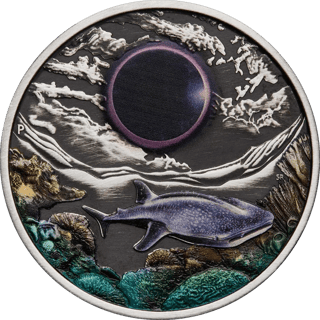 Ningaloo 2023, solar eclipseNingaloo 2023darkened Sun over a reefSun over the reef

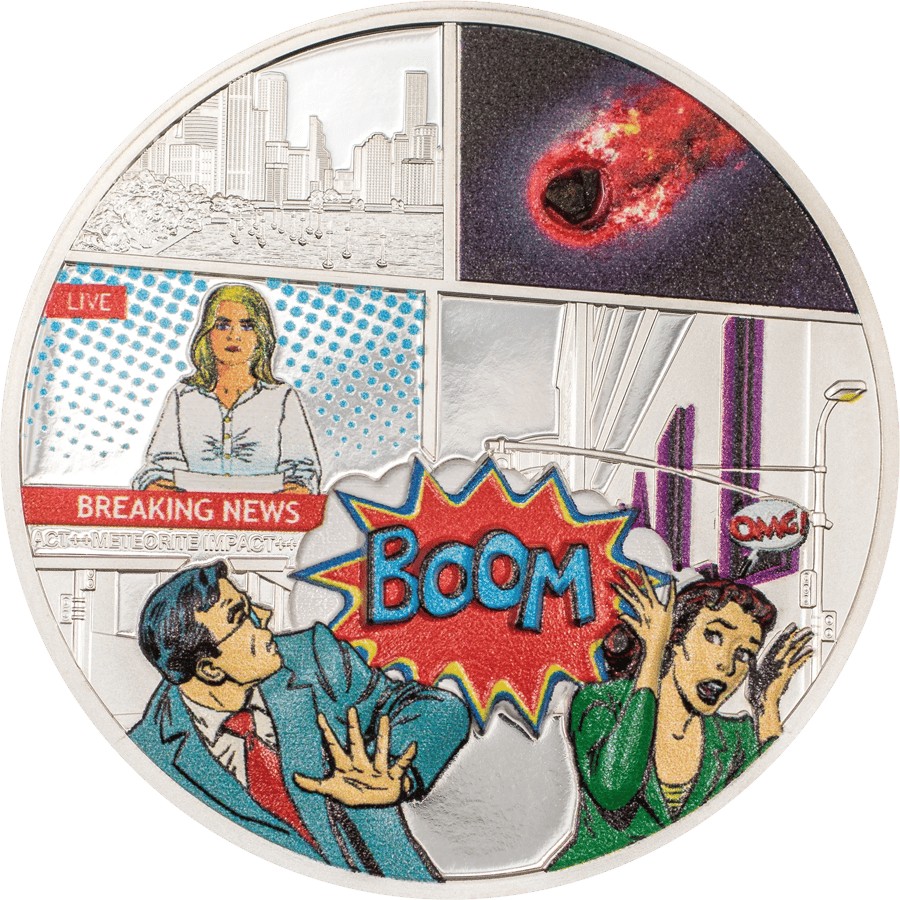
Twice, a mineral was found in nature for the first time in this stony meteorite: in 1969 and in 2014.
Ringwoodite is named after A. E. Ringwood; its violet grains were described in “Nature” in 1969.
In 2014 came bridgmanite, according to “Science” the most abundant solid phase in Earth. From the accompanying minerals, the researchers infer peak shock values of about 24 gigapascals and 2,300 kelvin. This ended a search lasting half a century.
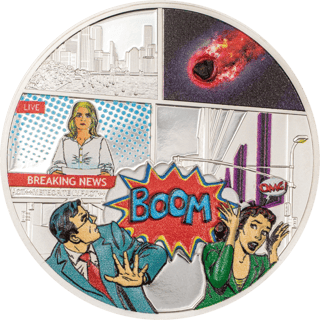
The Tenham Meteorite coin tells of an impact as a comic page, with “BREAKING NEWS” and “BOOM”.
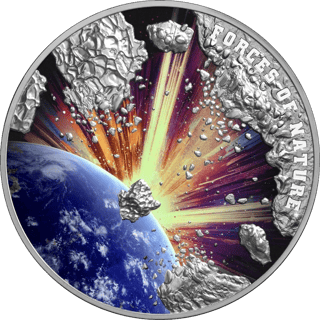 Forces of Nature 2023Forces of Nature 2023a shattering boulder above EarthBoulder above Earth
 Space
Stay informed with product launches, financial news and exclusive offers. Sign up for our free newsletter today.
By entering your email address and clicking the "Submit" button, you give the following consent: "I agree to be informed by email about new products, financial news and exclusive offers, and therefore consent to the processing of my email address for the purpose of sending the newsletter. I can revoke this consent at any time without giving reasons, with effect for the future. The lawfulness of processing carried out prior to revocation remains unaffected."